

Business Strategy · Operations · Leadership
As businesses scale, founders often reach a point where vision alone
is no longer enough. Teams become larger, operations become more
complex, priorities compete for attention, and execution begins to
slow. The question is no longer "What should we build?" but
rather "How do we ensure the business executes consistently?"
At this stage, many leadership teams begin exploring different
operational support models. Some hire a full-time Chief Operating
Officer, others engage a Fractional Integrator,
while businesses implementing the Entrepreneurial Operating System®
often work with an EOS Implementer®. Although these
roles can appear similar at first glance, they serve very different
purposes and are designed for different stages of business growth.
Understanding the distinction between a Fractional
Integrator, an EOS Implementer® (often
searched as EOS Implementer), and a full-time
operational executive is essential before making a leadership
investment. Choosing the right model can improve accountability,
strengthen execution, align teams, and help founders focus on
strategic growth rather than day-to-day operational challenges.
This guide compares each approach in detail—explaining what these
roles do, when they deliver the most value, how they differ, and how
to determine which operational leadership model is the best fit for
your organization's current stage of growth.
Why Growing Businesses Struggle With Execution
Most growing businesses do not struggle because the founder lacks
ideas. They struggle because execution becomes harder as the company
expands. More customers, more employees, more meetings, more
projects, and more decisions can quickly create operational drag.
In the early stage, founders often manage everything directly. They
make key decisions, guide teams, solve customer problems, review
priorities, and personally push projects forward. That works for a
small team. But as the business grows, founder-led execution starts
becoming a bottleneck.
This is where operational leadership becomes important. A growing
company needs someone who can convert strategy into execution,
create accountability, improve communication, and ensure that teams
are moving in the same direction.
Common signs your business needs stronger execution leadership
- Important initiatives keep getting delayed.
- Team members are busy but priorities remain unclear.
- The founder is still involved in too many operational decisions.
- Meetings happen often, but accountability is weak.
- Department leaders are not fully aligned.
- Growth is creating complexity faster than systems can handle it.
- Customer delivery depends too much on individual effort.
- The company has vision, but execution feels inconsistent.
When these problems appear, founders usually begin considering one
of three options: hiring a full-time operations leader, bringing in a Fractional Integrator, or working with an EOS Implementer to adopt a structured operating
system.
What Is a Fractional Integrator?
A Fractional Integrator is an experienced
operational leader who works with a company on a part-time,
contract, or fractional basis to help turn strategy into execution.
The role is especially useful for businesses that need senior
operational guidance but are not yet ready, or do not yet need, a
full-time COO.
Unlike a consultant who only advises, a Fractional Integrator is
typically involved in execution. They help clarify priorities,
create operating rhythms, align leadership teams, improve
accountability, and ensure that business goals move from discussion
to measurable progress.
A Fractional Integrator typically helps with:
- Leadership team alignment
- Strategic priority execution
- Operating meeting structure
- Cross-functional accountability
- Process improvement
- Department coordination
- Founder support
- Execution discipline
- Growth planning
- Operational problem solving
For many businesses, a Fractional Integrator provides the missing
execution layer between the founder's vision and the team's
daily work. This can be particularly valuable for startups,
agencies, SaaS companies, professional services firms, and
owner-led businesses moving from founder-driven operations to a more
structured leadership model.
What Is an EOS Implementer?
An EOS Implementer® is a trained professional who
helps businesses adopt and run the Entrepreneurial Operating System,
commonly known as EOS. Many founders also search for this role as{" "}
EOS Implementer without the trademark symbol, but
both terms generally refer to a professional who guides companies
through the EOS framework.
The role of an EOS Implementer is different from the role of a
Fractional Integrator. An EOS Implementer typically helps the
leadership team understand, install, and use the EOS methodology.
They facilitate sessions, teach the framework, introduce tools, and
help the organization build habits around vision, traction, and
accountability.
However, an EOS Implementer usually does not operate inside the
business every week as an execution leader. Their primary value is
framework implementation, leadership facilitation, and helping the
company use EOS effectively.
An EOS Implementer commonly helps with:
- Introducing the Entrepreneurial Operating System
- Facilitating leadership team sessions
- Clarifying company vision
- Helping teams define rocks and quarterly priorities
- Teaching EOS tools and meeting structures
- Improving accountability through the EOS process
- Helping leadership teams improve communication
- Building discipline around scorecards and issue solving
For companies that want to fully adopt EOS, an EOS Implementer® can
be a valuable guide. But if the company needs someone to actively
manage execution, coordinate departments, and drive operational
progress between leadership meetings, a Fractional Integrator may be
the more practical fit.
What Does a Full-Time Operations Hire Do?
A full-time operations hire, such as a COO, Head of Operations, or
Director of Operations, becomes a permanent part of the leadership
team. This person is responsible for overseeing internal operations,
improving execution, managing teams, building systems, and ensuring
the business runs effectively day to day.
Unlike a Fractional Integrator, a full-time hire is deeply embedded
in the company. They are available every day, manage ongoing
operational issues, and carry long-term responsibility for execution
across the organization.
A full-time operations leader usually owns:
- Daily operational management
- People and team leadership
- Department performance
- Process development
- Internal systems
- Execution of company strategy
- Resource planning
- Operational KPIs
- Leadership team accountability
A full-time operations leader makes sense when the company has
enough complexity, budget, and management need to justify a
permanent executive role. For many growing businesses, that point
comes later than founders expect.
Most Founders Get This Wrong
Before hiring a full-time operations executive, make sure you're
solving the right execution problem—not simply adding another
leadership title.
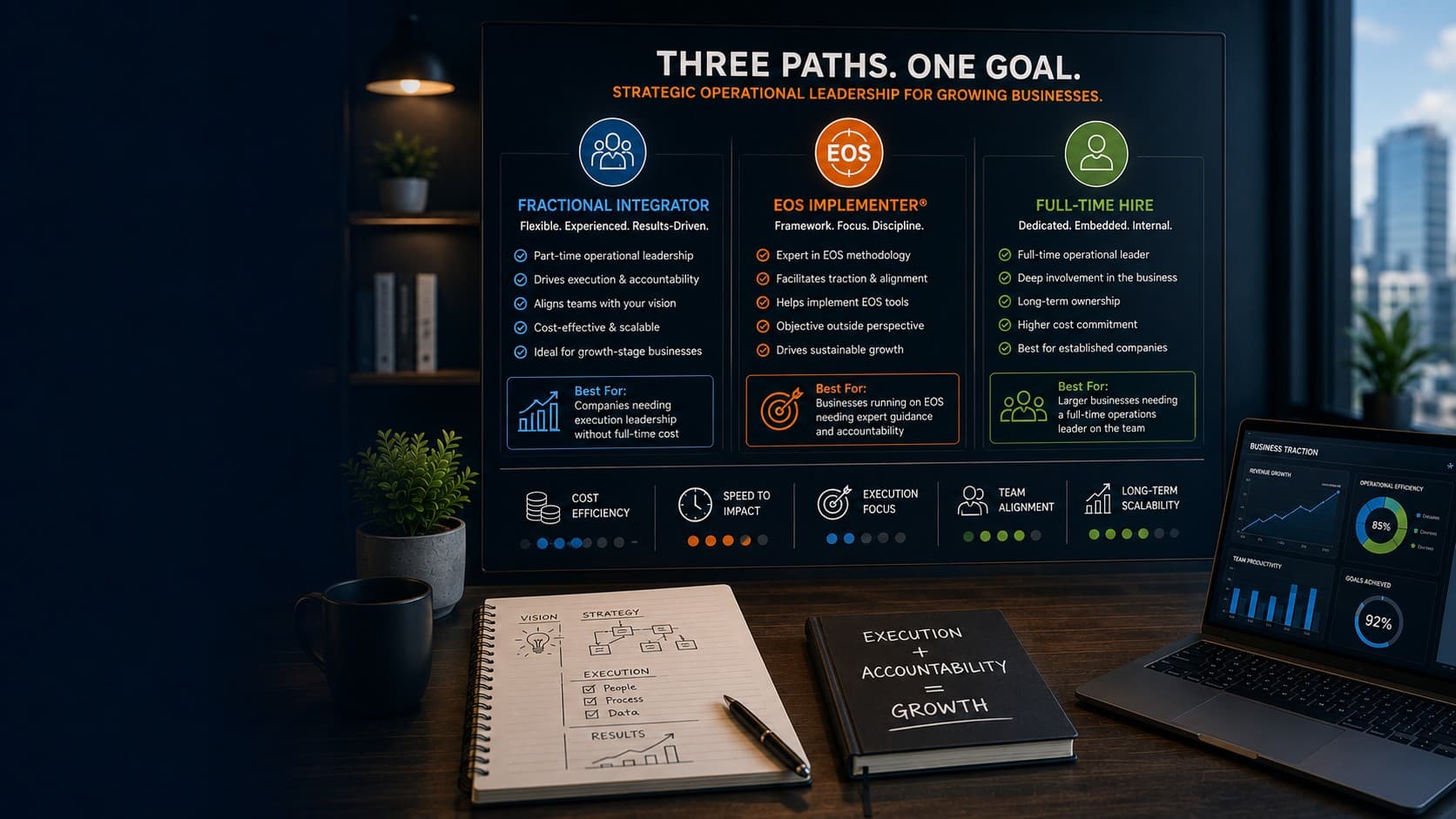
Fractional Integrator vs. EOS Implementer vs. Full-Time Hire at a
Glance
While these three leadership options all aim to improve execution,
they approach the challenge from very different perspectives. One
focuses on operational leadership, another specializes in
implementing a proven business operating system, and the third
becomes a permanent executive responsible for company-wide
operations.
| Comparison | Fractional Integrator | EOS Implementer® | Full-Time Hire |
|---|---|---|---|
| Primary Focus | Operational execution | EOS implementation | Daily business operations |
| Leadership Role | Fractional executive | External facilitator | Permanent executive |
| Team Management | Supports leadership | Limited | Direct responsibility |
| Strategic Execution | High | Medium | High |
| EOS Expertise | Optional | Primary specialization | Depends on experience |
| Best For | Growing businesses needing execution | Companies adopting EOS | Mature organizations with ongoing operational demands |
| Typical Commitment | Part-time / Fractional | Workshop & coaching engagement | Full-time employee |
Which Option Is Right for Your Business Stage?
The right choice depends less on company size and more on your
current business challenges. A founder struggling with execution has
very different needs from a leadership team implementing EOS or an
established company hiring its first Chief Operating Officer.
Choose a Fractional Integrator if:
- Your business is growing faster than operations can support.
- You need senior operational leadership without a full-time salary.
- Your leadership team lacks alignment and accountability.
- You want someone actively involved in execution.
- The founder is overwhelmed by day-to-day operations.
Choose an EOS Implementer® if:
- You have committed to implementing the EOS framework.
- Your leadership team needs structured facilitation.
- You want guidance on Vision, Traction, and accountability tools.
- You need an experienced EOS coach rather than an operational executive.
Choose a Full-Time Operations Leader if:
- Your organization requires daily executive oversight.
- You have multiple departments with dedicated leadership teams.
- Your budget supports a permanent C-suite executive.
- You need someone fully embedded in the business every day.
Cost Difference: Fractional Integrator, EOS Implementer, and
Full-Time Hire
Cost is one of the biggest reasons founders compare these three
options. A full-time operations leader can be a significant
investment when salary, benefits, bonuses, recruitment fees, and
long-term employment costs are considered. For many growing
businesses, that level of commitment may be too early.
A Fractional Integrator usually gives the business
access to senior operational leadership at a lower total cost than a
full-time executive. This can be ideal when the company needs
execution support, accountability, and leadership structure but does
not yet require someone in the seat every day.
An EOS Implementer is typically priced around
facilitation, coaching, and implementation sessions. This investment
can be valuable when the company wants to adopt the Entrepreneurial
Operating System, but it may not replace the need for someone to
actively drive execution inside the business.
Cost comparison by business need
- Fractional Integrator: Best when you need hands-on execution leadership without a permanent executive cost.
- EOS Implementer®: Best when you want structured EOS facilitation and guidance from an external expert.
-
Full-Time Hire: Best when operational leadership
is required every day across multiple departments.
The lowest-cost option is not always the best choice. The right
decision depends on the problem you are trying to solve. If your
issue is lack of execution, a Fractional Integrator may create
faster operational value. If your issue is lack of operating
framework, an EOS Implementer may be more appropriate. If your issue
is ongoing operational complexity, a full-time hire may eventually
become necessary.
The Most Common Mistake: Hiring Before Diagnosing the Problem
Many founders jump straight to hiring when execution starts breaking
down. But before choosing between a Fractional Integrator, an EOS
Implementer, or a full-time COO, the leadership team should first
diagnose what is actually missing.
Some companies do not need a full-time operations executive yet.
They need clearer priorities, better meeting rhythms, stronger
accountability, and someone who can integrate teams around the
founder's vision. In that situation, a Fractional Integrator
may solve the problem more efficiently.
Other companies are not ready for execution support because the
leadership team has not aligned around a shared operating system.
They may benefit from an EOS Implementer who can introduce structure
and help the team adopt EOS tools before adding operational
leadership.
A full-time operations hire becomes the right decision when the
company has reached a level of complexity where operational
leadership is required every day. Hiring too early can create fixed
cost without enough organizational maturity to fully use the role.
Get a Reality Check on Your Roadmap
Not sure whether you need a Fractional Integrator, an EOS
Implementer, or a full-time operations leader? Start by
clarifying the real execution gap in your business.
How a Fractional Integrator Supports Founder-Led Companies
Founder-led companies often reach a stage where the founder becomes
the central point for every important decision. Sales needs approval,
operations needs direction, product teams need priorities, and
managers need clarity. While this founder-driven model works early,
it eventually slows the business down.
A Fractional Integrator helps reduce this pressure
by creating a stronger operating rhythm across the company. Instead
of the founder personally pushing every initiative forward, the
Fractional Integrator helps leadership teams clarify goals, assign
accountability, track progress, and resolve execution gaps.
This does not mean the founder loses control. In many cases, the
founder gains more strategic freedom because daily operational
coordination no longer depends entirely on them.
A Fractional Integrator can help founders:
- Move from reactive management to structured execution.
- Reduce operational dependency on the founder.
- Improve leadership team accountability.
- Create clearer communication between departments.
- Translate vision into quarterly and monthly priorities.
- Identify bottlenecks before they slow growth.
- Build repeatable operating systems.
This is why many founders choose a Fractional Integrator before
hiring a full-time COO. They need execution leadership, but they may
not yet have enough scale, budget, or organizational complexity to
justify a permanent executive role.
Where an EOS Implementer Fits Best
An EOS Implementer® fits best when the leadership
team wants to adopt the Entrepreneurial Operating System and needs
an expert facilitator to guide that process. The EOS Implementer
helps the team understand the framework, run sessions, define rocks,
clarify issues, and build discipline around the EOS model.
This can be extremely useful for companies that lack a common
operating language. If every department is working differently and
leadership meetings lack structure, EOS can create a shared system
for vision, traction, and accountability.
However, founders should understand that an EOS Implementer is not
automatically the same as a Fractional Integrator. The EOS
Implementer teaches and facilitates the framework. A Fractional
Integrator typically gets closer to weekly execution and helps drive
operational progress inside the business.
EOS Implementer is usually best when:
- Your leadership team wants to fully adopt EOS.
- You need structured facilitation from an external expert.
- Your company lacks a shared operating language.
- You want better meeting discipline and issue-solving structure.
- You need help installing EOS tools and rhythms.
For companies already committed to EOS, the EOS Implementer can be
the right first step. But if the team already understands its
strategy and needs someone to actively drive execution, a Fractional
Integrator may provide more immediate operational leverage.
Can a Business Use Both a Fractional Integrator and an EOS Implemente?
Yes. In fact, many growing businesses benefit from both roles—but
at different stages or for different purposes. Rather than viewing a
Fractional Integrator and an EOS Implementer as competing solutions, founders
should understand how each contributes to the company's long-term
success.
An EOS Implementer helps leadership teams adopt the
Entrepreneurial Operating System by introducing its tools,
facilitating workshops, and creating alignment around vision,
accountability, and execution. Once that framework is established,
a Fractional Integrator can help ensure those systems continue to
work effectively during day-to-day operations.
In other words, an EOS Implementer installs the operating
framework, while a Fractional Integrator helps the business execute
consistently within that framework. Depending on the company's
maturity, these roles can complement one another rather than
replace one another.
A common progression looks like this:
- Leadership team recognizes execution challenges.
- Business adopts EOS with guidance from an EOS Implementer.
- Leadership meetings become more structured.
- Quarterly priorities become clearer.
- A Fractional Integrator helps maintain execution momentum.
- The company eventually hires a full-time COO when scale requires it.
Every business follows a different journey, but understanding how
these roles fit together helps founders avoid hiring too early or
investing in the wrong type of operational support.
Questions Every Founder Should Ask Before Choosing
Before deciding between a Fractional Integrator, an EOS
Implementer, or a full-time operations executive, founders should
step back and evaluate the real operational challenges facing the
business—not simply react to symptoms.
Ask yourself:
- Is our biggest challenge execution or strategy?
- Do our leaders have clear accountability?
- Are projects consistently delivered on time?
- Do departments communicate effectively?
- Are we trying to install an operating system like EOS?
- Do we need an advisor, an execution partner, or a permanent executive?
- Can our current budget support a full-time COO?
- Will fractional leadership deliver faster ROI?
Honest answers to these questions usually make the right decision
much clearer. Businesses that focus on solving the underlying
operational challenge—not just filling an executive position—are
more likely to build sustainable growth.
Key Insight
There is no universally "better" option. A Fractional Integrator, an EOS Implementer, and a full-time operations
leader each solve different business problems. The right choice
depends on your company's stage of growth, operational maturity,
leadership capacity, and long-term objectives.
Final Thoughts
Choosing between a Fractional Integrator, an EOS Implementer, or a full-time operations leader
is not about selecting the most impressive title—it is about
identifying the leadership model that best fits your current stage
of growth.
If your business already has a clear vision but struggles to execute
consistently, a Fractional Integrator can provide
operational leadership, accountability, and execution without the
long-term commitment of a permanent executive.
If your leadership team wants to adopt the Entrepreneurial Operating
System®, an EOS Implementer can provide the
structure, facilitation, and guidance needed to successfully
implement the EOS framework across the organization.
And if your company has reached the point where day-to-day
operations require dedicated executive oversight across multiple
departments, hiring a full-time COO or operations executive may be
the right long-term investment.
The important takeaway is that each option solves a different
business problem. Understanding those differences allows founders to
invest in operational leadership that accelerates growth instead of
adding unnecessary management complexity.
Need Help Choosing the Right Operational Leadership Model?
Every growing business reaches a point where stronger operational
leadership becomes essential. Whether you're evaluating a
Fractional Integrator, considering working with
an EOS Implementer®, or deciding if it's time to
hire a full-time COO, the right choice depends on your business
goals, team maturity, and growth stage.
At KSoft Technologies, we work closely with founders and business
leaders to improve execution, streamline operations, build
scalable business systems, and prepare organizations for
sustainable growth.
Key Takeaways
- A Fractional Integrator focuses on operational execution, leadership alignment, and accountability.
- An EOS Implementer® specializes in helping businesses successfully adopt the Entrepreneurial Operating System®.
- A full-time operations executive becomes part of the leadership team and manages daily operational performance.
- Growing businesses often benefit from fractional leadership before making a permanent executive hire.
-
There is no universally correct answer—the best choice depends
on your business stage, operational complexity, budget, and
leadership needs.
Frequently Asked Questions
What is the difference between a Fractional Integrator and an EOS Implementer?
A Fractional Integrator works alongside the
leadership team to improve operational execution, align
departments, and ensure business priorities are delivered.
An EOS Implementer, on the other hand,
focuses on helping organizations successfully implement the
Entrepreneurial Operating System® by facilitating leadership
sessions and introducing the EOS methodology.
Can a business use both a Fractional Integrator and an EOS Implementer?
Yes. Many growing companies first work with an EOS
Implementer® to establish the EOS framework and later engage
a Fractional Integrator to drive ongoing execution,
accountability, and operational leadership inside the
organization.
When should a company hire a full-time COO instead of a Fractional Integrator?
A full-time COO becomes the better choice when operational
complexity requires dedicated executive leadership every day.
Earlier-stage businesses often achieve better value from a
Fractional Integrator because they receive senior operational
expertise without the long-term financial commitment of a
permanent executive.
Is a Fractional Integrator the same as a Fractional COO?
Not always. While there is significant overlap, a Fractional
COO generally owns operational leadership responsibilities,
whereas a Fractional Integrator primarily focuses on aligning
strategy, people, processes, and execution. In many growing
businesses, however, one experienced executive may perform
both roles.
Which option is most cost-effective for a growing business?
The answer depends on the company's needs. Businesses seeking execution support often find a Fractional Integrator to be the most cost-effective solution. Companies committed to the Entrepreneurial Operating System may benefit more from an EOS Implementer®, while larger organizations with significant operational complexity may justify the investment in a full-time COO.