
As a startup founder, turning your vision into reality is a thrilling and challenging journey. Every idea feels like a potential game-changer, but how do you know if it’ll actually work? This is where the Minimum Viable Product (MVP) comes in. An MVP isn’t about delivering perfection; it’s about proving that your idea works. As the saying goes, "An MVP isn't about perfection—it's about proving your idea works." By focusing on core features and solving the primary problem, an MVP paves the way for innovation, growth, and success without draining your resources.
What is an MVP?
A Minimum Viable Product (MVP) is the simplest version of your product that demonstrates its core value. Think of it as a prototype with just enough features to satisfy early adopters. It’s your product’s debut performance—meant to validate the concept, gather feedback, and guide future development.
As a startup, the MVP approach is like taking a test drive before buying a car. It lets you validate the market, save costs, and gain real insights into what your audience needs, all without committing to a fully-fledged product.
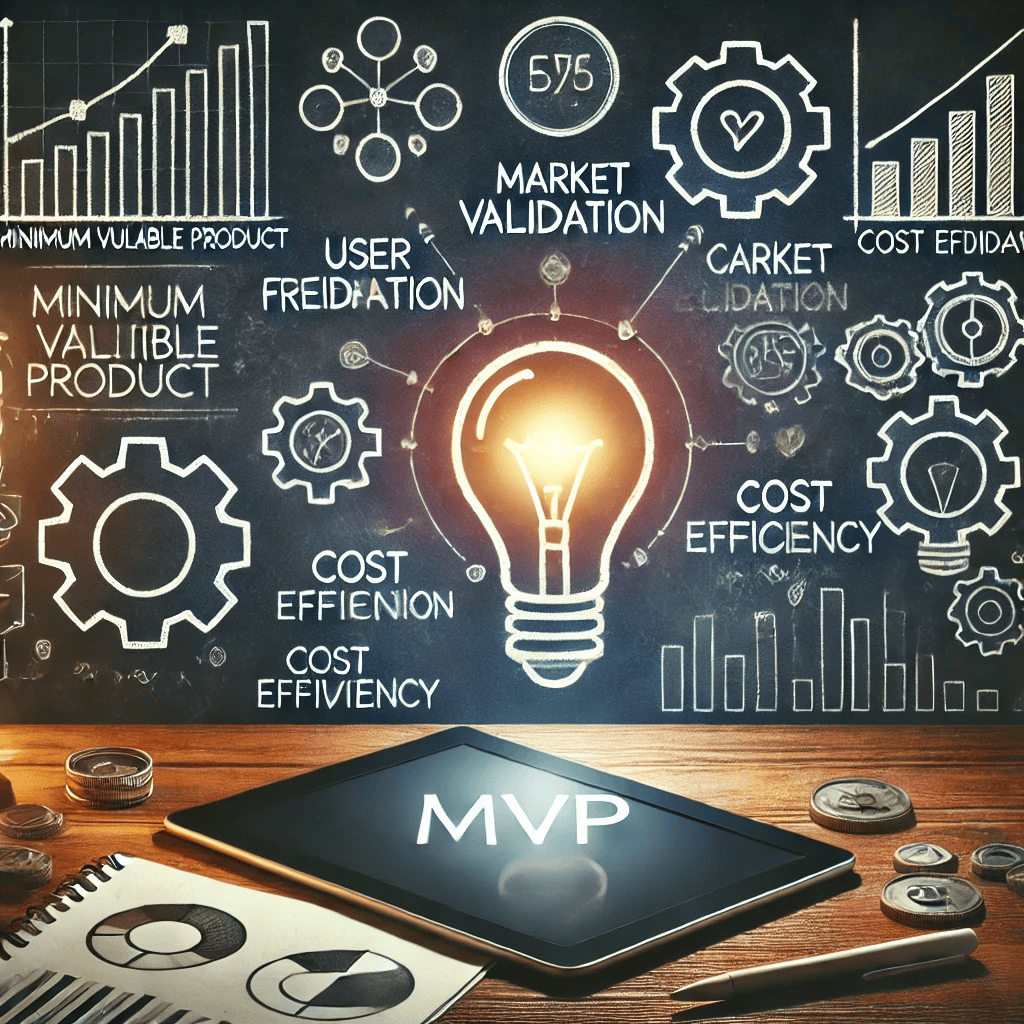
Why Should Startups Begin with an MVP?
Validate Your Idea Quickly: An MVP helps you test whether your idea resonates with the market. It’s your first step to answering, “Does this solve a real problem?”
Save Money and Resources: As a startup, budgets are tight. An MVP lets you avoid wasting resources on features that users don’t need.
Get Early Adopters: Early adopters can become your product’s biggest advocates, providing valuable feedback while helping you build a loyal user base.
Secure Funding: Investors love proof. An MVP showcases your concept’s potential, making it easier to attract funding.
Iterate and Improve: The feedback loop is invaluable. Your MVP gives you data to refine your product and avoid costly missteps.
Why MVPs Matter in Today’s Startup Ecosystem
Startups face fierce competition and rapidly changing markets. Here’s how an MVP keeps you ahead:
Adaptability: Pivot quickly based on user insights and stay agile in a dynamic environment.
Customer-Centricity: Involve users from day one, ensuring your product evolves based on real needs.
Competitive Edge: Launch fast, iterate faster, and stay ahead of competitors stuck in development cycles.
People Also Ask: Common MVP Questions from Founders
How do I decide what features to include in my MVP? Focus on solving the core problem. Ask, “What is the minimum my product needs to deliver value?”
Solution:
Prioritize features using frameworks like MoSCoW (Must-have, Should-have, Could-have, Won’t-have).
Survey potential users to identify pain points.
Remember, simplicity is key. Less is more.
What if my MVP doesn’t succeed? Failure at this stage isn’t the end; it’s a learning opportunity. It means you’ve identified what doesn’t work before investing heavily.
Solution:
Analyze feedback and identify gaps.
Pivot—adjust your product to better fit user needs.
Iterate smarter, not harder.
How do I make users take my MVP seriously? Even a basic product needs to offer value. Users should feel your MVP solves a real problem, even in its simplest form.
Solution:
Focus on user experience (UX) and design.
Be transparent about the MVP’s purpose.
Show users how their feedback shapes future updates.
Challenges Startups Face with MVPs
Overcomplicating the MVP: Trying to include too many features can dilute the product’s core purpose.
Solution: Stay disciplined. Focus on the one problem you’re solving and build only what’s necessary.
Ignoring Feedback: Early adopters’ insights are gold. Neglecting their feedback can lead to a product that misses the mark.
Solution: Actively listen to your users. Use both qualitative feedback and data-driven metrics to guide iterations.
Launching Too Early: An MVP doesn’t mean a buggy product. Poor execution can harm your startup’s reputation.
Solution: Test rigorously before launch. Ensure the MVP is functional, even if it’s basic.
Lack of Clear Objectives: Without goals, measuring success becomes difficult.
Solution: Define what success looks like for your MVP, whether it’s user numbers, engagement metrics, or conversion rates.

Success Stories: MVPs That Changed the Game
Airbnb: Started by renting out their own apartment to test if people would pay for short-term rentals. This simple MVP validated a billion-dollar idea.
Dropbox: Used a video demonstration to showcase their product’s potential. The idea attracted users and investors alike.
Instagram: Initially launched as Burbn, a multi-featured app. User feedback showed photo sharing was the standout feature, leading to its pivot and massive success.
Steps to Build Your MVP
Define the Problem: Identify the core issue your product solves.
Understand Your Audience: Get to know your target users and their needs.
Prioritize Features: Focus on the essentials that deliver value.
Build a Prototype: Develop a functional version of your idea.
Test with Early Adopters: Gather feedback and refine the product.
Iterate: Use insights to improve and expand your MVP.
Conclusion
As a startup founder, it’s natural to want your first product to be perfect. But an MVP teaches us that perfection isn’t the goal—validation is. By starting small, listening to users, and iterating quickly, you’ll build a product that not only works but thrives in the market.
An MVP isn’t just a product; it’s the foundation of your startup’s success story. It’s the bridge between your vision and the real world, built on courage, creativity, and adaptability. So embrace the MVP mindset, and let your startup’s journey begin!