A startup idea feels exciting in your head.
But the real challenge begins when you try to turn that idea into something users can actually touch, test, and trust.
Many founders do not fail because their idea is weak.
They fail because they move from idea to development without enough validation, clarity, user research, or product focus.
This guide explains how to turn a startup idea into MVP step by step, so you can move from concept to working product without wasting time, money, or resources.
What Is a Startup MVP?
A startup MVP, or minimum viable product, is the smallest usable version of a product that helps founders test whether a real market need exists. It includes only the core features required to solve one important user problem and collect meaningful feedback from early users.
An MVP is not a rough, broken, or incomplete product.
It is a focused version of your product designed to answer one question:
“Do users care enough about this problem to use or pay for a solution?”
KSoft Technologies positions its SaaS and MVP development approach around clarity before coding, NDA-first discussions, senior engineers, and studying the business before writing code. That aligns closely with how founders should approach MVP development: validate first, build second.
Step 1: Start With the Problem, Not the Product
Most founders begin with a solution.
“I want to build an app.”
“I want to build a SaaS platform.”
“I want to build an AI-powered tool.”
But the better starting point is the problem.
Before designing screens or hiring developers, answer:
- Who has this problem?
- How painful is it?
- How often does it happen?
- What are users doing today instead?
- Why are current solutions not enough?
- Would users pay for a better solution?
A strong MVP begins when the problem is clear enough that the product direction becomes obvious.
Have a Startup Idea But Not a Clear MVP Plan?
Before development starts, clarify the problem, first user, core workflow, and features that truly belong in version one.
Plan Your MVP Build Talk to Startup ExpertsStep 2: Define Your First Target User
A common founder mistake is building for too many people at once.
If your product is for “everyone,” your MVP will become unfocused.
Your first version should serve one specific user group.
Weak target user definition
“This product is for small businesses.”
Stronger target user definition
“This product is for small clinic owners who currently manage appointments and follow-ups through phone calls and spreadsheets.”
The second version gives your MVP direction.
It helps you decide what to build, what to ignore, what language to use, and how to measure success.
Step 3: Validate the Idea Before You Build
Validation does not mean asking friends whether your idea sounds good.
It means collecting real evidence from potential users.
You can validate a startup idea through:
- Customer interviews
- Landing page tests
- Waitlists
- Manual service delivery
- Clickable prototypes
- Paid pilot offers
- Pre-orders or early access signups
If users describe the problem in their own words, ask for access, join a waitlist, or agree to test your solution, you are moving closer to build-readiness.
Step 4: Create a Simple Value Proposition
Before moving into product planning, founders should be able to explain their startup in one clear sentence.
A useful framework is:
We help [target audience] solve [problem] by providing [solution].
Example:
We help independent fitness coaches manage clients, payments, and workout plans through a single SaaS platform.
If your value proposition feels confusing or requires a lengthy explanation, your MVP may not yet be focused enough.
Step 5: Map the User Journey Before Features
One of the biggest mistakes founders make is jumping straight into feature lists.
Instead, map the user journey first.
Ask:
- How does the user discover the product?
- What happens during sign-up?
- How do they complete the main task?
- What result do they receive?
- What makes them return?
This workflow becomes the foundation of your MVP architecture.
Features should support the journey—not the other way around.
What Features Should Be Included in an MVP?
MVP features should focus exclusively on solving the core user problem. Every feature should directly contribute to delivering the primary value proposition. Anything that does not support the main user outcome can typically wait until future releases.
Features that usually belong in an MVP
- User registration and login
- Core workflow functionality
- Basic dashboard
- Notifications
- Essential reporting
- Payment integration, if required
Features that often belong later
- Advanced analytics
- Multiple integrations
- Complex permissions
- AI enhancements
- White-label functionality
- Enterprise-level customization
A good rule:
If removing a feature still allows users to achieve the primary outcome, it probably does not belong in version one.
Step 6: Prioritize Features Using the MVP Filter
Once features are listed, classify them into three categories.
Must Have
Features without which the product cannot function.
Should Have
Features that improve usability but are not essential for launch.
Nice to Have
Features that can wait until after validation.
This exercise often removes 40–60% of planned functionality.
According to CB Insights startup failure research, building products nobody wants remains one of the leading reasons startups fail. Prioritization helps prevent that outcome.
Step 7: Research Existing Competitors
Many founders avoid competitor analysis because they believe originality is everything.
The reality is different.
Competitors provide valuable insight into:
- Market expectations
- Pricing models
- User experience patterns
- Common complaints
- Feature gaps
- Growth opportunities
Study:
- Product reviews
- Reddit discussions
- G2 reviews
- Capterra reviews
- LinkedIn comments
- Product Hunt launches
Often the fastest path to differentiation comes from solving a problem existing competitors ignore.
Ready to Convert Your Idea Into a Real Product Roadmap?
Validation, feature prioritization, user flows, and technical planning determine whether an MVP succeeds or becomes an expensive experiment.
Discuss your startup roadmap with experienced product strategists before development begins.
Discuss Your MVP Roadmap View Case StudiesStep 8: Define Success Before Development Starts
A surprising number of startups launch products without defining what success looks like.
Before development begins, establish measurable MVP goals.
Examples of MVP success metrics
- 100 active users in first month
- 20 paying customers within 90 days
- 40% weekly retention rate
- 50 customer interviews completed
- 10 pilot customers onboarded
These metrics help founders evaluate whether the product is gaining traction or requires iteration.
Step 9: Choose the Right Technology Approach
Technology choices should support business goals rather than personal preferences.
Founders often become distracted by trends, frameworks, and buzzwords.
The MVP stage is about speed, reliability, scalability, and maintainability.
Questions to answer
- Will the product be web-based, mobile-based, or both?
- Will subscriptions be required?
- Does the product need third-party integrations?
- Will AI features be included immediately or later?
- How many users are expected in year one?
- Will enterprise customers require special functionality?
Teams like KSoft Technologies often help founders align technical architecture with business priorities so that early development decisions do not become expensive limitations later.
Step 10: Build the Right MVP Team
A startup MVP is rarely built by a single developer.
Even simple products benefit from a balanced team structure.
Typical MVP team
- Product strategist
- UI/UX designer
- Frontend developer
- Backend developer
- QA tester
- Project manager
Depending on budget and complexity, some roles may overlap.
What matters most is having accountability, communication, and a clear roadmap.
Step 11: Create a Realistic MVP Budget
Startup founders frequently underestimate both development costs and post-launch expenses.
Your MVP budget should include more than coding.
MVP budget categories
- Product strategy and planning
- UI/UX design
- Frontend development
- Backend development
- Quality assurance testing
- Hosting and infrastructure
- Third-party tools and APIs
- Maintenance and bug fixes
- Marketing and user acquisition
Building a budget early prevents founders from running out of resources before reaching product-market validation.
Step 12: Prepare for Launch Before Writing Code
Product launch preparation should begin long before development is completed.
Successful startups build audience and demand while the MVP is still under development.
Pre-launch preparation checklist
- Create a landing page
- Collect waitlist signups
- Build an email list
- Interview potential customers
- Develop onboarding materials
- Prepare support documentation
- Plan beta testing
- Define launch metrics
Launching to an existing audience is significantly easier than launching to nobody.
What Does a Successful MVP Development Process Look Like?
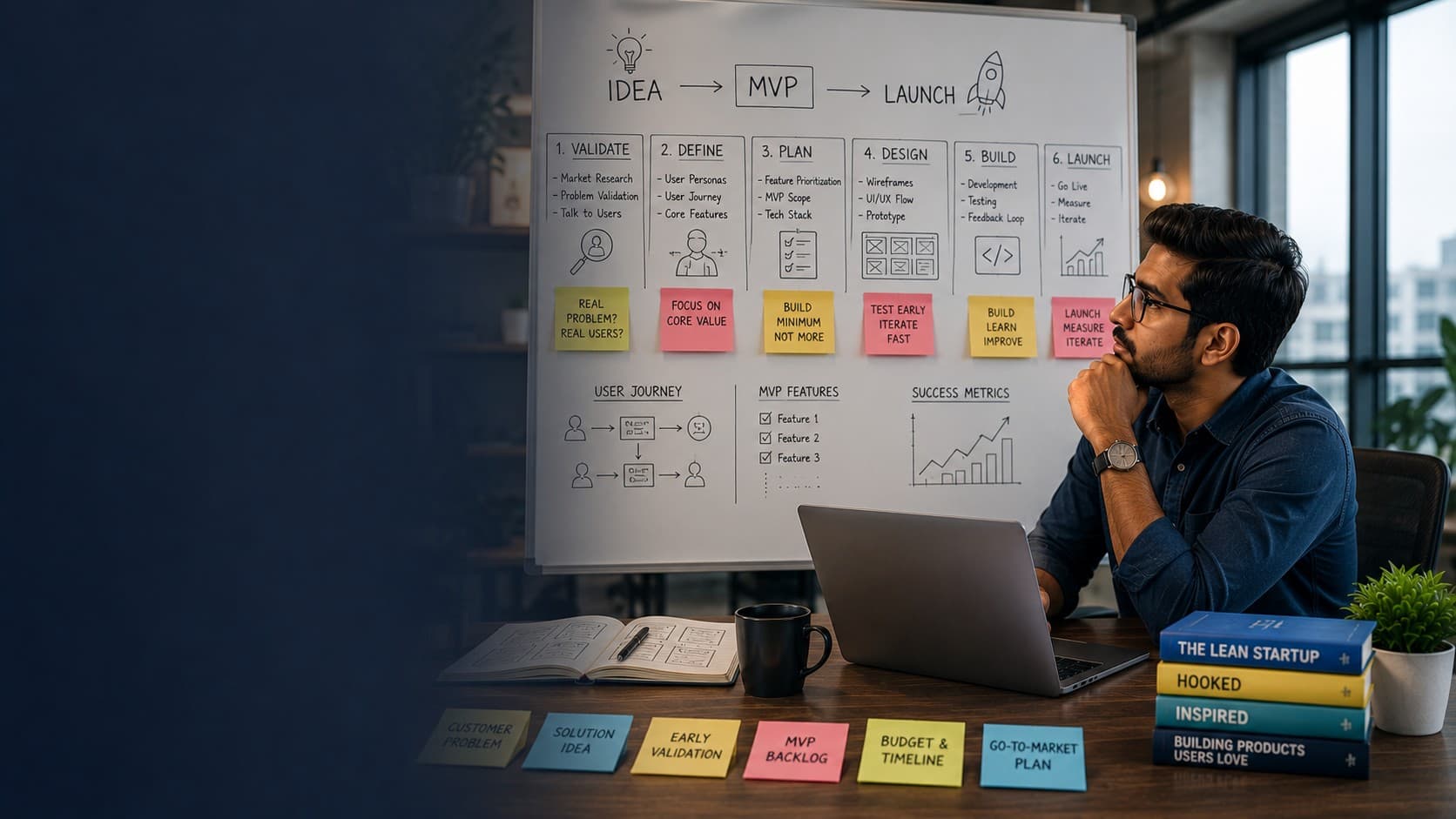
A successful MVP development process follows a structured sequence: problem validation, customer discovery, feature prioritization, user flow planning, technical architecture, development, testing, launch, and feedback collection. Skipping any major stage often increases risk, delays timelines, and reduces product-market fit.
The ideal founder workflow
- Identify a meaningful problem
- Validate demand
- Define target users
- Create user journeys
- Prioritize MVP features
- Choose development approach
- Build MVP
- Launch to early users
- Measure engagement
- Iterate based on feedback
This sequence reduces uncertainty and maximizes learning before major investments are made.
Founder Example: From Idea to MVP
Imagine a founder who notices that independent consultants struggle to manage proposals, contracts, invoices, and client communication across multiple tools.
Instead of immediately building a large business platform, the founder interviews 30 consultants.
The interviews reveal that proposal creation is the biggest pain point.
The MVP becomes a focused proposal-generation platform rather than a complete business management suite.
After launch, early users request contract automation and invoicing. Those features become Phase Two.
This approach reduces development costs, accelerates launch, and validates demand before expansion.
Common Founder Mistakes When Turning an Idea Into an MVP
- Building before validation
- Adding too many features
- Ignoring customer interviews
- Choosing technology before strategy
- Not defining success metrics
- Skipping user testing
- Launching without an audience
- Hiring purely on cost
- Delaying launch until the product feels "perfect"
Most successful startups launch sooner, learn faster, and improve continuously rather than attempting to build the perfect product from day one.
Ready to Transform Your Startup Idea Into a Market-Ready MVP?
The difference between successful startups and stalled projects is usually clarity, validation, and execution.
Whether you are a first-time founder or scaling your next venture, a structured MVP roadmap can help reduce risk and accelerate learning.
Start Planning Your MVPSpeak With Our TeamFinal Thoughts
Turning a startup idea into a working MVP is not about building faster.
It is about building smarter.
The founders who succeed are usually not the ones with the most features, the biggest teams, or the largest budgets.
They are the founders who validate early, prioritize ruthlessly, listen to users, and treat their MVP as a learning tool rather than a finished product.
If you follow the process outlined in this guide, you dramatically improve your chances of launching a product users actually want.
Frequently Asked Questions
How do I turn a startup idea into an MVP?
Start by validating the problem, interviewing potential users, defining your target audience, prioritizing essential features, mapping user journeys, and then building only the smallest version needed to test demand.
What comes first: validation or development?
Validation should always come before development. Understanding customer needs reduces risk and helps ensure the product solves a real market problem before significant resources are invested.
How many features should an MVP have?
An MVP should contain only the features required to solve the primary user problem. Every additional feature increases complexity, cost, and development time.
How long does MVP development usually take?
Most startup MVPs take between 6 and 16 weeks depending on complexity, feature scope, integrations, team size, and technology requirements.
Can non-technical founders build an MVP?
Yes. Many successful startups are launched by non-technical founders who focus on customer validation, product strategy, and choosing the right development partners.
How much does it cost to build an MVP?
MVP costs vary widely depending on functionality, platform requirements, integrations, and team structure. Costs can range from a few thousand dollars to significantly larger investments for complex products.
Should I build a website or MVP first?
A landing page often comes first because it helps validate interest, collect leads, and test messaging before investing in full product development.
What is the biggest MVP mistake founders make?
The most common mistake is building too many features before validating demand. Complexity often delays learning and increases startup risk.
How do I know if my idea is validated?
Validation occurs when real users demonstrate genuine interest through interviews, signups, waitlists, pilot participation, purchases, or repeated engagement.
What happens after the MVP launches?
After launch, founders should collect feedback, analyze user behavior, measure key metrics, and prioritize improvements based on real-world usage.