From Idea to First Customer in 100 Days — Without Writing a Single Line of Code
The biggest lie in the India startup world is that you need to be technical to validate a business idea. You don't. What you need is the right process — and 100 days of disciplined execution.
You have a business idea. Maybe you've had it for months. A problem you know exists, a solution you can see clearly in your head, a market you understand better than anyone.
And then someone asks: "Can you code?" And when the answer is no, everything stalls. You start looking for technical co-founders. You get development quotes that feel impossibly large. You read about no-code tools and spend three weeks learning them and build something that half-works. And the idea — the good one, the one grounded in real knowledge of a real problem — sits untouched while you try to figure out the technical side.
This is the wrong order. Completely backwards.
Validation — proving that real people will pay for your idea — does not require code. It does not require a finished product. It requires a process. And that process, done correctly, gets you to your first paying customer in 100 days without you writing a single line of code yourself.
The Myth That Kills More India Startups Than Anything Else
The myth is this: you need to build the product before you can sell it.
It sounds logical. It feels responsible. Why would anyone pay for something that doesn't exist yet?
But think about how most successful businesses actually started. A catering business takes orders before buying the industrial kitchen. A tailoring shop takes measurements and deposits before cutting fabric. A consultant sells their time before they've delivered the engagement. Selling before the thing is fully built is not deception — it is validation. It is the market telling you that the thing is worth building.
Software is no different. And yet founders in Kerala and across India consistently feel that until the product is built, they have nothing to offer. The result is months of building, followed by a launch into silence, followed by the painful discovery that nobody wanted exactly what was built.
What Validation Actually Means
Validation is not someone saying "that's a great idea." Friends say that. Family says that. Even strangers at networking events say that. None of it means anything.
Validation is one of three things, in increasing order of strength:
- Someone gives you their time. A 30-minute conversation with a potential customer who had no prior relationship with you, where they stayed engaged and asked follow-up questions, is a weak signal. Useful. Not conclusive.
- Someone gives you their data. A potential customer who joins a waitlist, fills out a detailed onboarding form, or shares internal information about their problem is a stronger signal. They've invested something real.
- Someone gives you their money. A deposit, a pre-order, a paid pilot, a letter of intent with a financial commitment. This is the only signal that matters for real validation. Everything else is opinion. Money is conviction.
The 100-day process is designed to get you to the third level — someone gives you their money — before a finished product exists. That is your validation. That is what tells you the product is worth building.
"Every founder I've worked with who got to their first customer fast did one thing the slow ones didn't: they asked for money before the product was ready. The ones who waited until the product was finished to ask for money almost always found out something important was wrong — after they'd already built it." — Krishna Kumar, KSoft Technologies, Kerala
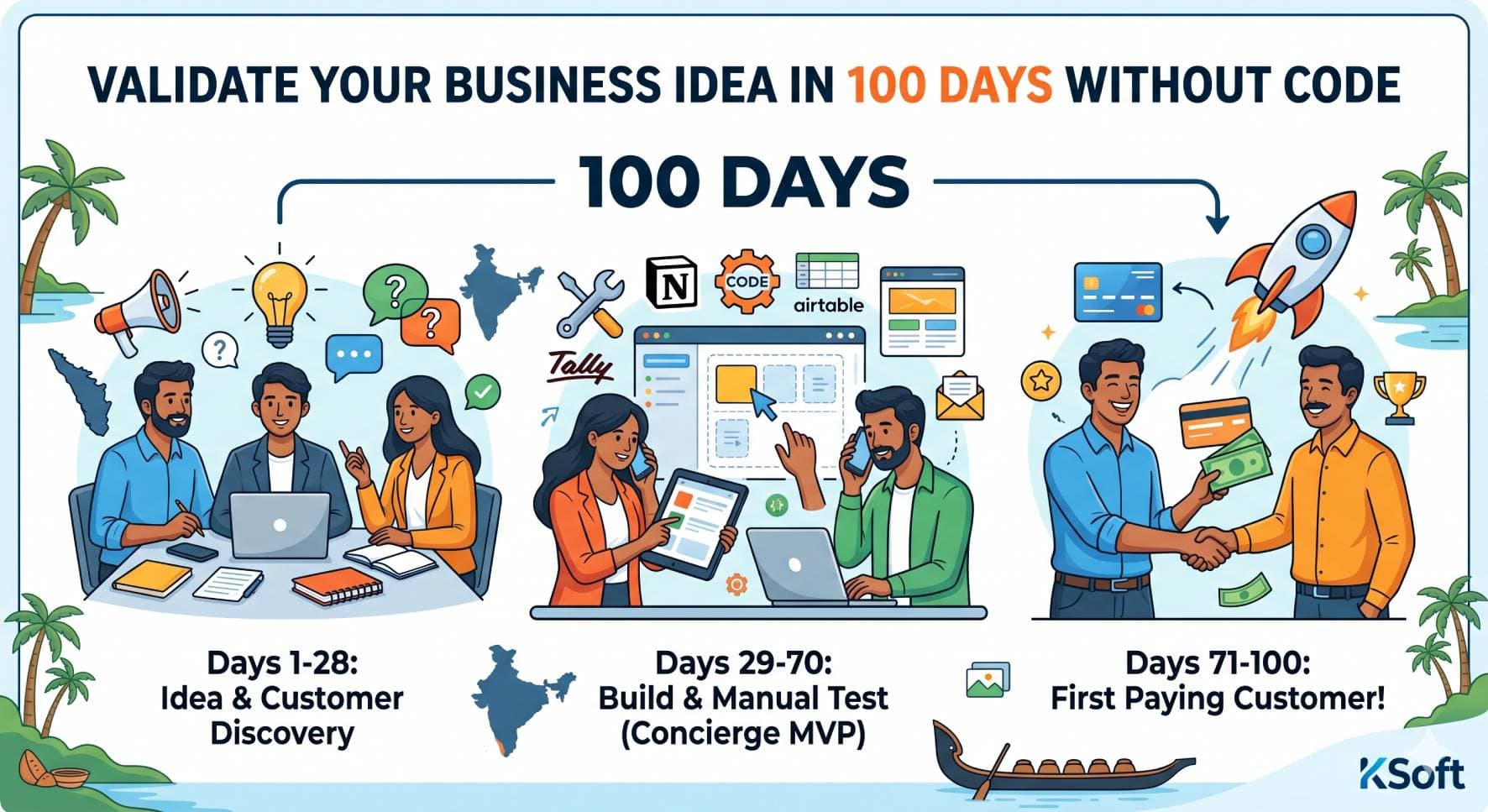
The 100-Day Validation Process: Phase by Phase
This process works for any business idea that involves a product or service someone pays for regularly — software, consulting, a platform, a service business with a repeatable delivery model. Here is how the 100 days are structured:
Phase 1 Days 1 – 14
Idea Sharpening — From Vague to Specific
Most business ideas start vague. "A platform for SMEs." "An app for healthcare." "A tool for teachers." These are categories, not ideas. The first two weeks are spent sharpening the idea into something specific enough to sell. Who exactly has the problem? What does their day look like when the problem is happening? What do they currently do about it — and what does that cost them in time, money, or frustration? By the end of day 14, you have a one-paragraph description of the idea that is specific enough that a real person could read it and immediately know whether it applies to them.
Phase 2 Days 15 – 28
Customer Discovery — 20 Real Conversations
Not surveys. Not Google Forms sent to WhatsApp groups. Twenty real conversations with real people who match the profile of your target customer. People with no prior relationship to you. The goal is not to pitch — it is to listen. What language do they use to describe the problem? How often does it happen? What have they already tried? What would make them switch to something new? These conversations reshape the idea and produce the exact language you'll use when you eventually sell. Founders who skip this phase build products for an imaginary customer.
Phase 3 Days 29 – 42
The Offer — Sell the Outcome, Not the Product
Based on the discovery conversations, you build an offer. Not a product — an offer. A clear statement of what problem you solve, for whom, what the result looks like, and what it costs. This goes on a simple landing page (no code required — Tally, Notion, or even a well-formatted WhatsApp message works at this stage). The offer is sent to the most promising people from your discovery conversations with a clear ask: "Would you pay ₹X for this? If yes, here's how to get started." This is where validation happens or doesn't.
Phase 4 Days 43 – 70
Manual Delivery — Serve the First Customers Without Full Technology
This is the phase that surprises most founders. Once you have paying customers, you serve them — manually, if necessary. If you're building a software product, you deliver the core outcome by hand while the technology is being built in parallel. A recruitment platform manually matches candidates. An invoicing tool manually generates invoices. A logistics product manually coordinates deliveries. This is called a "concierge MVP" and it is the fastest way to learn what the product actually needs to do from real paying customers who are paying precisely because the outcome has value to them.
Phase 5 Days 71 – 85
Learning & Iteration — What the Manual Delivery Taught You
By day 70, you have been delivering your product or service manually for four weeks. You now know things about the problem that no amount of customer discovery could have told you. You know which parts of the delivery customers care most about. You know which parts they barely notice. You know what they ask for that you hadn't anticipated. You know what they would pay more for. This shapes the brief for the technology build — not a guess about what to build, but a specification informed by real delivery to real paying customers.
Phase 6 Days 86 – 100
Technology Brief & Build Kickoff
Day 100 doesn't end with a finished product. It ends with something far more valuable: a validated idea, paying customers, deep knowledge of what to build, and a clear brief for the technology team. When KSoft Technologies starts a build based on a validated brief from this process, the development is faster, cheaper, and produces something customers actually use — because the product spec came from real customer behaviour, not a founder's assumptions. You hand over a brief built from evidence. The team builds from that.
Book a free 30-minute clarity call with Krishna Kumar. Walk away with a clear first step — whether or not you're ready to build.
Book Free Clarity CallCommon Objections — And Why They Don't Hold
"Nobody will pay for something that doesn't exist yet."
They will, if the problem is real and the offer is specific enough. "I will help you reduce the time your team spends on monthly GST reconciliation from three days to three hours, starting next month. The first two businesses to sign up pay ₹8,000 for the first three months." That is a specific offer for a specific problem with a specific outcome and a specific price. Real businesses facing that problem every month will consider it. The vague version — "I'm building a GST tool, would you be interested?" — gets nothing.
"I don't have a network of potential customers."
You don't need one. You need twenty conversations. LinkedIn has every type of business owner in Kerala and across India. Startup Mission events, district-level business associations, WhatsApp groups for specific industries — the people you need to talk to are accessible. What most founders lack is not access. It is the willingness to have conversations where the answer might be no.
"I need the product to be good before I show it to anyone."
This is perfectionism, not prudence. A potential customer evaluating a pre-product offer is evaluating whether the problem is real and whether they trust you to solve it. They are not evaluating feature completeness. The product doesn't exist yet — they know that. What they're buying is the outcome and the confidence that you can deliver it.
"This only works for simple ideas."
It works for ideas of any complexity. The manual delivery phase (Phase 4) is specifically designed for complex ideas — it is how you deliver a complex outcome without the full technology in place. The complexity of the eventual product doesn't change the validity of the process. It changes the length of the manual delivery phase and the size of the technology brief at the end.
Why This Particularly Applies to Kerala Founders
Kerala has a specific economic and social structure that makes this validation approach especially powerful.
The state has a high density of SMEs — in tourism, healthcare, retail, construction, education, and agriculture — that are run by owners with deep domain expertise but limited technology adoption. These owners understand their problems intimately. They are also, in many cases, the exact people a Kerala-based founder has genuine access to through existing community, professional, or family networks.
A founder with a family connection to the cashew processing industry has access to potential customers that no amount of marketing budget can replicate. A founder who grew up in a family running an ayurveda clinic understands the operational pain of that business in a way no market research report can capture. These are genuine competitive advantages — and they are most powerful during the validation phase, when personal access and domain credibility matter more than technology.
The NRI dimension matters here too. Kerala's diaspora — particularly across the Gulf — represents both a customer base and a source of validation. A product that solves a problem for Keralites living abroad (property management back home, family financial oversight, document management for NRI paperwork) has a natural early customer base that is reachable, willing to pay, and underserved by existing solutions.
The Relationship Between Validation and Technology
This is not an argument against building technology. KSoft Technologies builds software. The argument is about sequencing.
Technology built before validation is expensive to change when the market tells you something is wrong — and the market always tells you something is wrong. Technology built after validation, based on a brief informed by real customer behaviour, is built correctly the first time. It solves the right problem in the right way for people who have already demonstrated they'll pay for it.
The founders who come to KSoft Technologies with a validated brief — paying customers, real delivery experience, specific product requirements drawn from that experience — get a better product built faster and at lower cost than founders who come with an idea and a list of features. Because we're not guessing. Neither are they.
That is what 100 days of validation produces. Not just a customer. A foundation for everything that comes after.
Your Idea Is Worth Testing. Start the 100 Days.
You don't need code. You don't need a technical co-founder. You need a process and the discipline to follow it. The first customer is closer than you think.
Book Free Clarity Call See Case Studies