
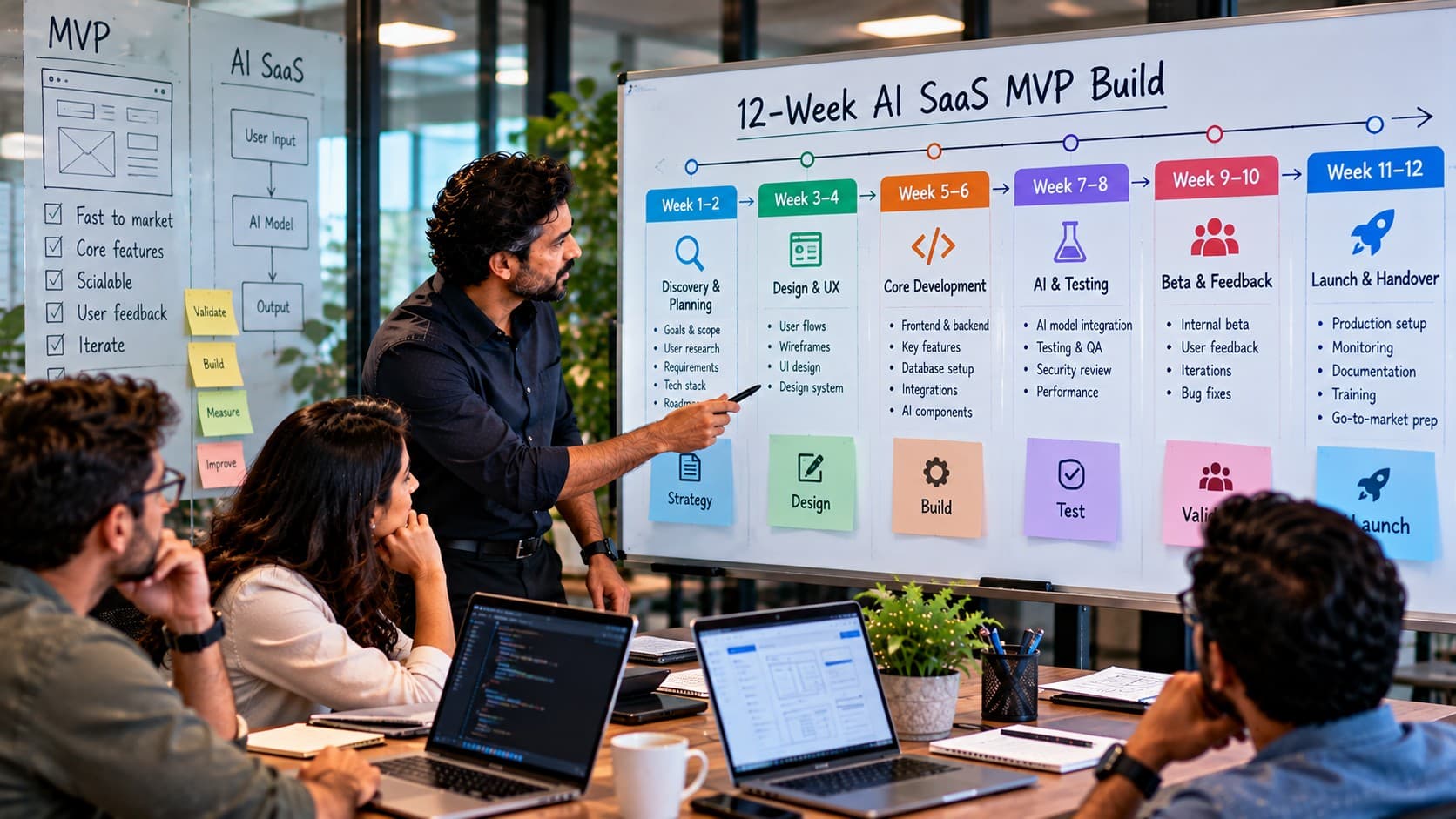
A founder-focused checklist of weekly delivery evidence, from discovery and AI feasibility to acceptance testing, launch and ownership transfer. Use it to compare agency proposals without confusing a polished demo with a usable product.
Two agencies promise the same launch date. One quote includes discovery, a working AI workflow, testing and a handover. The other says it will “build your platform” and lists a dozen features. The timelines look similar; the commitments do not.
An AI MVP agency should be evaluated on what it can demonstrate each week, who owns each decision and which risks it intends to test before launch. A polished interface at week eight is little comfort if the model cannot handle realistic customer inputs, usage costs are unknown or one customer can see another customer’s data.
For a founder without an engineering team, the difficulty is knowing what to ask before signing. Do you need a custom model? Which integrations belong in version one? When should you receive repository access? What counts as an accepted milestone? The agency should be willing to explain these questions without hiding behind architecture diagrams.
The twelve-week schedule below is an illustrative delivery baseline for a narrowly scoped AI-enabled SaaS MVP, not a universal promise. Products involving regulated information, unfamiliar data sources, complex permissions or experimental model behavior may need more time. Use the schedule to test a proposal, identify omissions and negotiate a delivery contract that exposes problems early.
What can a 12-week AI MVP actually include?
A twelve-week AI MVP can include a defined customer journey, a usable web application, one bounded AI-assisted workflow, authentication, necessary data controls, basic usage monitoring, and a controlled launch. It rarely includes every integration, an entirely new foundation model, enterprise-wide compliance certification, and a mature analytics platform at once. The difference is disciplined scope.
Consider a support-team assistant that drafts replies from approved help documents. The user signs in, selects a ticket, reviews a generated answer with citations and approves the reply. That is a testable commercial workflow. Adding voice agents, multilingual search, CRM automation and a custom-trained model on the same timeline may turn a focused MVP into several separate products.
Before comparing estimates, ask every agency to quote the same one principal user, one core job, one AI outcome. Ask it to identify what it will deliberately omit. If the quote does not disclose its exclusions, the headline timeline has little value.
The existing SaaS MVP development process at KSoft Technologies describes scoping, authentication, role permissions and deployment as distinct project elements. Those foundations matter just as much for AI-enabled software.
What should an AI MVP agency prove before development?
A credible AI MVP agency should prove that it understands the target user, the business task, the information the AI may access, how outputs will be evaluated, and what the founder will approve. Its proposal should describe exclusions, dependencies, milestone evidence, responsibility for cloud and model charges, and the ownership terms for the delivered software.
Ask for a sample milestone acceptance sheet, not a generic portfolio deck. It should show a deliverable, the environment where it can be tested, the acceptance criteria, the responsible reviewer and the decision required to move forward.
- Product evidence: a named user, workflow map and narrow release goal.
- Technical evidence: data flow, permissions, integration assumptions and hosting plan.
- AI evidence: representative test inputs, acceptable error classes and a fallback when confidence is insufficient.
- Commercial evidence: milestone payments, change-request rules, source-code rights and post-launch support.
For AI systems, an impressive demonstration using carefully selected examples is not equivalent to evidence from a repeatable evaluation set. Agree on the evaluation method before a live customer sees the feature.
Does the quote define a testable MVP?
Compare the proposed milestones with a scoped SaaS build before committing your budget.
Review the MVP Build Approach1. Week 1: Scope the user problem and success test
Deliverable: a signed product brief, workflow map, prioritized backlog, exclusions and a list of open assumptions. The founder names the first buyer and the action that the software should help them complete.
What to review
Walk through a real customer example from input to output. Record how the user completes the job today, what can go wrong and which outcome would count as useful. Make a decision on one core workflow rather than voting on features.
What to watch for
If discovery consists only of collecting screens to design, it misses the commercial question. The agency must identify whose behavior will validate the MVP and what evidence would justify adding more features later.
2. Week 2: Audit data and test AI feasibility
Deliverable: data inventory, access and consent assumptions, representative sample inputs and an AI feasibility note. For a retrieval-based assistant, that means checking document quality, update frequency, permission boundaries and whether correct answers can be located.
What to review
Ask the agency to demonstrate difficult samples as well as easy ones. Include missing documents, vague requests, conflicting sources and out-of-scope questions. Agree on how sensitive information must be handled and on the human review path.
What to watch for
A promise to “train the AI on your files” is not a design. Your quote should state which model or provider is assumed, whether retrieval or fine-tuning is proposed, and which evidence supports that choice.
3. Week 3: Approve screens and technical boundaries
Deliverable: reviewable wireframes, user journeys, architecture decisions and an environment plan. Mark which screens are necessary for the core task and where the user can correct or reject an AI response.
What to review
Confirm account creation, basic roles, data ownership and the planned storage of prompts, outputs and feedback. Test the wireframes with someone who did not help design them. Their confusion is valuable before implementation becomes expensive.
What to watch for
Architecture that has no explanation of tenant isolation, authentication or secrets management creates hidden launch work. A founder does not need to choose every framework, but should receive a plain-language explanation of major trade-offs.
4. Week 4: Show a working end-to-end thin slice
Deliverable: an early functional path from login to one real AI-assisted result, even if the interface is unfinished. It should run in a shared test environment and use realistic data with appropriate access permissions.
What to review
Have the agency repeat the same task in front of you with two different inputs. Check what happens when the model fails, returns an incomplete answer or times out. Record defects and decisions in a visible issue tracker.
What to watch for
Animations, polished dashboards and static mock outputs are not a functioning thin slice. A live demonstration should show application behavior, API calls and failures, not a carefully rehearsed slide presentation.
5. Week 5: Build the core workflow and feedback loop
Deliverable: the primary user flow, persistent records, task status and an explicit way to accept, revise or reject AI output. The system should separate information supplied by the user from instructions controlled by the application.
What to review
Inspect whether the generated result can be traced to its input and version of the workflow. Ask what the customer sees when an answer is unavailable. Confirm that feedback is stored without exposing another customer’s information.
What to watch for
An AI feature that always produces something, even when it should abstain, can create more operational work than it saves. The agency should show bounded behavior, not merely higher output volume.
6. Week 6: Establish AI evaluation and cost controls
Deliverable: a versioned test set, evaluation rubric, baseline results, latency tracking and an estimate of model usage cost per typical task. Evaluation cases must include errors, prompt injection attempts and examples that should require human review.
What to review
Agree on the release threshold for the most damaging errors. For each model or prompt revision, rerun the same cases and document whether results improved or regressed. Model charges, retrieval costs and retry behavior belong in the operating assumptions.
What to watch for
A single “accuracy” percentage hides different harms. Separate unsupported answers, missed relevant information, permission violations and unusable outputs. An agency should report these categories even if the overall demonstration looks strong.
7. Week 7: Connect the minimum supporting services
Deliverable: only the integrations required to complete the paid-for job. That may include a payment provider, one CRM connection, email delivery or a document source. Each integration needs a known failure and retry path.
What to review
Run a test with expired credentials, duplicate events and an unavailable third-party service. Verify where an administrator can see failures and whether users are told the task is pending rather than incorrectly marked complete.
What to watch for
Every additional integration introduces vendor limits, data-sharing questions and support obligations. Keep speculative integrations outside the fixed scope until pilot users prove they are necessary.
8. Week 8: Complete permissions, logging and deployment
Deliverable: role-based access controls, tenant separation tests, audit events, controlled secrets, backup and restore approach, and a repeatable release pipeline. The application must be recoverable without the agency engineer’s laptop.
What to review
Ask for two separate test accounts representing different customers, then try cross-account access. Review who can change prompts, export data, approve AI actions and inspect usage logs. Ensure the cloud account and repository ownership are contractually clear.
What to watch for
Security is not a final-week checkbox. OWASP documents risks including prompt injection and sensitive information disclosure in large-language-model applications. The design should restrict tool permissions and validate actions outside the model itself.
9. Week 9: Run founder acceptance tests with real tasks
Deliverable: a founder-led acceptance test report showing the primary user journey, known defects and fixes ranked by release impact. Test with realistic examples, sanitized if necessary, from the intended buyer’s working day.
What to review
Ask a prospective user to complete the task without coaching. Capture how long they spend, where they hesitate and whether the AI output needs substantial rewriting. Keep a distinction between usability issues and model-quality issues.
What to watch for
Do not let a backlog of attractive secondary features displace correction of the core workflow. An MVP should first demonstrate that a specific customer can obtain reliable value from its main task.
10. Week 10: Test failure modes and release readiness
Deliverable: a release checklist covering functional testing, security findings, load assumptions, model fallback, backups, monitoring, privacy notices and support ownership. The team should document unresolved risk rather than marking everything green.
What to review
Test rate limits, malformed inputs, unexpectedly large files, service interruptions and attempts to obtain unauthorized information. Verify alerts, logs and the procedure for disabling the AI capability without taking down the whole product.
What to watch for
A vendor that promises a “production-ready AI platform” without specifying acceptable risks, remediation responsibilities or a rollback procedure is offering an undefined standard.
11. Week 11: Pilot with a small group and refine onboarding
Deliverable: controlled pilot access, user instructions, feedback log, incident contact and a prioritized release decision. The pilot should be small enough that the team can directly investigate failed tasks and understand unexpected usage.
What to review
Track completed core tasks, reasons for human intervention, customer comprehension and actual model usage spend. Confirm that a participant understands when they are receiving AI-generated content and what they are expected to verify.
What to watch for
Pilot participation is not product-market fit. A handful of positive comments cannot replace evidence that users return and that the workflow solves a problem worth paying for.
12. Week 12: Launch deliberately and complete handover
Deliverable: a go/no-go report, deployed release, source repository access, architecture notes, environment and credential ownership, operational runbook, known-issue register, maintenance terms and a prioritized next-release backlog.
What to review
The founder should be able to invite a customer, access metrics, understand a failed request, locate the deployment and change the agency without losing the product. Confirm support response arrangements, defect warranty and who pays for cloud or AI usage after launch.
What to watch for
A handover that begins only after the final invoice is paid leaves avoidable leverage and risk. Ownership, access and documentation should have been tested throughout the build, not promised at the end.
Where should a founder spend review time?
The chart below is a planning aid, not measured industry data. Its relative review-effort levels reflect the need for founder decisions, realistic testing and risk sign-off across the illustrative schedule.
| Week | Review effort | Main review subject |
|---|---|---|
| Week 1 | Moderate | Scope the user problem and success test |
| Week 2 | Moderate | Audit data and test AI feasibility |
| Week 3 | Moderate | Approve screens and technical boundaries |
| Week 4 | High | Show a working end-to-end thin slice |
| Week 5 | High | Build the core workflow and feedback loop |
| Week 6 | High | Establish AI evaluation and cost controls |
| Week 7 | Moderate | Connect the minimum supporting services |
| Week 8 | Very high | Complete permissions, logging and deployment |
| Week 9 | High | Run founder acceptance tests with real tasks |
| Week 10 | Very high | Test failure modes and release readiness |
| Week 11 | Moderate | Pilot with a small group and refine onboarding |
| Week 12 | High | Launch deliberately and complete handover |
High-review weeks deserve reserved time on the founder's calendar. If a quote assumes a founder is unavailable for reviews until launch, the schedule is missing an important dependency.
A 12-week timeline needs evidence at every gate
Discuss a delivery plan that includes AI evaluations, user testing and a clear handover.
Discuss Your MVP MilestonesHow do you compare agency quotes beyond the headline price?
Put every proposal into a common comparison sheet. Request the same milestone map, acceptance criteria, itemized exclusions and ownership terms from each supplier. The cheapest estimate may omit evaluation, security or handover work that appears later as change requests.
- Normalize the scope: define one user workflow, planned release environment and required integrations.
- Compare evidence: specify what working software or documents are due at weeks two, four, six, nine and twelve.
- Separate operating charges: model tokens, cloud services, data tools, transactional email and paid integrations may recur after launch.
- Check dependency ownership: identify who supplies data, approves content, arranges API credentials and performs acceptance testing.
- Read the exit terms: confirm code ownership, repository access, documents, warranty and transition support.
Illustrative scenario: A non-technical founder wants an AI assistant that searches approved contracts and drafts internal summaries. Agency A quotes a lower amount but excludes document permission rules and evaluation. Agency B includes a limited document connector, role-based access checks and an explicit test set. Without those details, the offers do not describe the same product.
Use an existing SaaS MVP scoping reference to challenge estimates, but insist on the AI-specific controls in your own agreement. A fixed-price contract is only useful when acceptance criteria are detailed enough to settle disagreements.
How KSoft Technologies Helps Evaluate an AI MVP Build
We approach an MVP proposal by clarifying the first customer workflow, the technical foundations and the written scope that must be approved before implementation. That includes practical decisions about access permissions, core product features, integrations and deployment.
Our project assessment conversation can help founders describe the intended outcome and surface the assumptions behind a proposed milestone plan. For additional development-related discussions, the KSoft Technologies YouTube channel is another reference point.
We would not recommend a fixed twelve-week commitment for every AI product. Data readiness, the evidence required to trust the model and obligations around privacy can change the feasible scope.
A credible twelve-week plan ends with a decision, not a demo
A strong agency proposal makes uncertainty visible early. By the second week, you should know what is being built and where the risky assumptions lie. By the fourth, a thin slice should make the workflow tangible. In the middle of the engagement, evaluation results and failure handling should become visible. Near launch, customer testing should determine whether the release is appropriate.
The final milestone is not a promise that every feature will be finished. It is evidence that the agreed scope has been built, tested and transferred into an environment your organization controls. Sometimes the right decision at week twelve is a narrower launch, another test cycle or a change in the problem being solved.
Before selecting an agency, ask for its week-six evidence pack: what will it show about model quality, data protection, user experience and recurring cost? If the answer is vague, clarify it before discussing a discount. A clear milestone contract protects both the founder and the delivery team.

Compare the work behind your agency quotes
Bring your scope and proposals to a project assessment focused on deliverables, risks and ownership.
Request an Agency Scope ReviewFrequently Asked Questions
What should an AI MVP agency deliver in the first two weeks?
The first two weeks should produce a written product scope, defined first user, core workflow, exclusions, data inventory, early feasibility evidence and a test plan. Ask for concrete files and a review meeting, not a broad statement that discovery is complete. Those deliverables determine whether the proposed schedule is credible.
Why can an AI MVP take longer than an ordinary web application?
AI behavior must be tested against uncertain inputs, shifting model outputs and information-access rules. Traditional application testing remains necessary, while model evaluations, fallback behavior, provider costs and data controls add distinct work. A narrowly defined AI task can fit a short schedule; an experimental model or complex data integration often cannot.
How should founders judge an AI demo from an agency?
Ask the agency to run unfamiliar examples, including incomplete information, conflicting documents and a request the system should refuse. Watch how it communicates uncertainty and whether humans can correct the result. A repeatable evaluation dataset is more persuasive than a polished demonstration using only preselected examples.
What is the difference between a prototype and a SaaS MVP?
A prototype demonstrates an interaction or technical possibility; a SaaS MVP lets a real user complete a defined job under controlled operating conditions. That usually requires authentication, permissions, persistent data, monitoring and support ownership. A clickable design or single model prompt can validate a concept without being ready for paying customers.
Should an AI MVP use an existing model or a custom model?
Most teams should test an existing model first unless product requirements show that specialized training is necessary. Retrieval, structured prompts, business rules and human review may solve the initial problem with less operational burden. Any custom-model proposal should explain the training data, evaluation advantage, maintenance work and added cost.
Can a non-technical founder manage a twelve-week MVP project?
Yes, provided the agency creates reviewable artifacts and clear acceptance gates. The founder should own the buyer problem, approve scope changes, test the user journey and make go/no-go decisions. Technical staff should own implementation and disclose risks in plain language. Independent technical review can help when security or architecture is complex.
When is a twelve-week agency timeline unrealistic?
Twelve weeks is unlikely to be enough when source data is unavailable, integration approvals are uncertain, regulatory review is extensive or the core AI behavior still requires research. Complex mobile applications, many customer roles and multiple enterprise systems can also extend delivery. A trustworthy agency explains which assumptions must hold before promising a date.
How can I compare two AI MVP development quotes fairly?
Give both agencies the same written scope and require line items for discovery, design, core workflow, AI evaluation, security, testing, deployment and handover. Compare exclusions, responsibilities and acceptance criteria before price. Ask who pays for model usage and third-party services and what triggers a change request.
How much should I budget for an AI SaaS MVP?
An AI SaaS MVP budget depends on the feature boundary, user roles, integrations, data quality, AI behavior, security requirements and support period. Separate one-time development fees from ongoing cloud, model and maintenance charges. Avoid treating a single agency headline price as comparable unless both estimates cover the same deliverables and assumptions.
How do I verify source-code and intellectual property ownership?
Require contract terms covering ownership, permitted third-party components, repository access and delivery of configuration and deployment instructions. Confirm the organization controls the code repository and relevant cloud accounts during the project. Ask how credentials, model-provider accounts and licensed dependencies transfer. Legal counsel should review any ambiguous ownership or licensing provisions.
What should happen after the MVP goes live?
The agency or an internal owner should monitor errors, usage, model costs, user feedback and release incidents. A defined support period should clarify response expectations and responsibility for defects. Product decisions should be driven by observed user tasks and repeated failures, rather than immediately adding every feature deferred during discovery.
Should I hire an agency or build the MVP with an internal team?
Choose an internal team when it has the required product, application, AI and security skills plus enough capacity to own delivery. An agency may suit a founder who needs coordinated execution and documented milestones without building a permanent team immediately. Either route needs clear scope, access control, evaluation criteria and a planned owner after launch.