
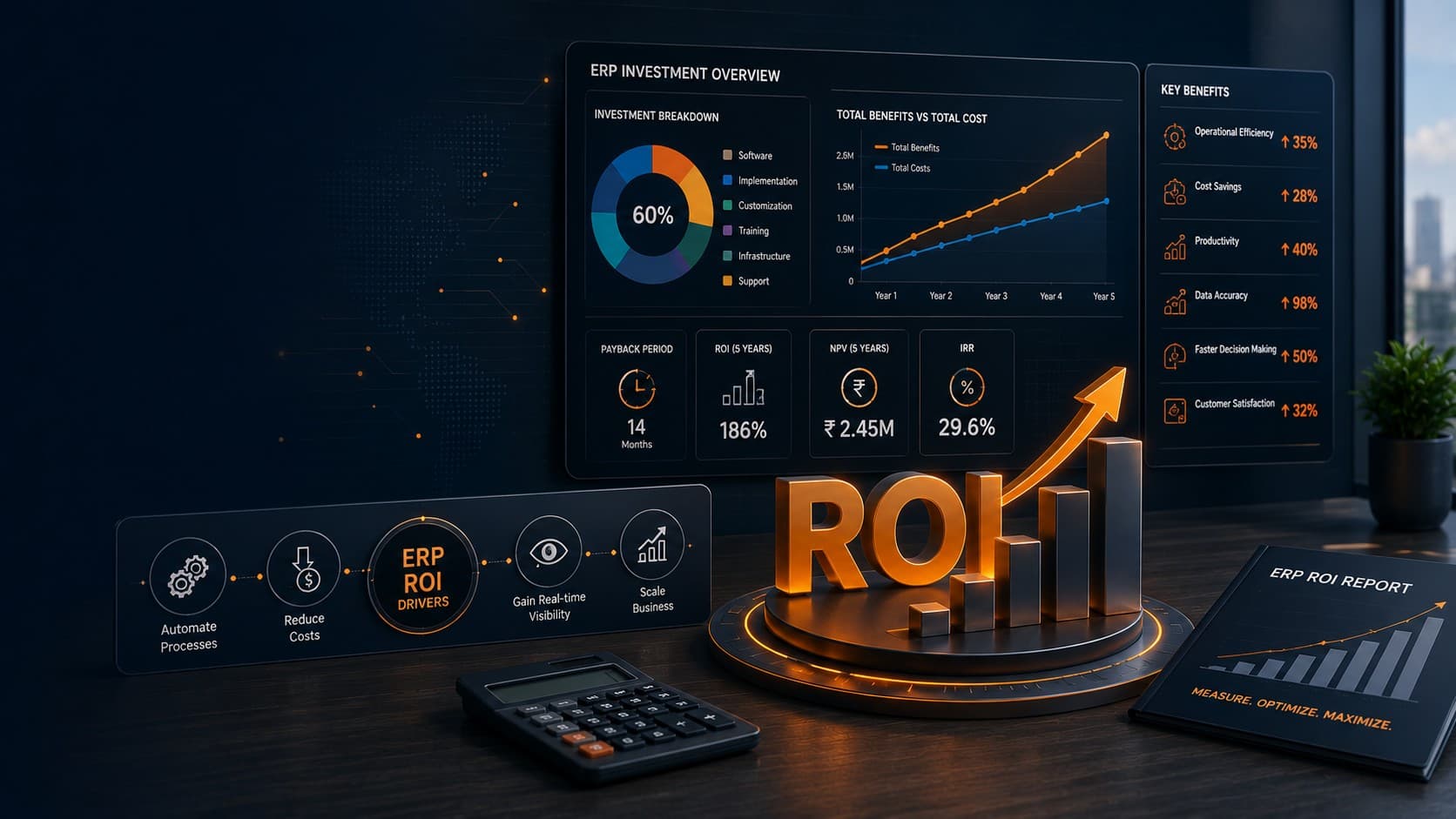
An ERP system is often one of the largest technology investments a business makes. Yet many organizations evaluate its success only by asking whether the software was delivered on time and within budget. Those factors matter—but they don't answer the most important question: Has the ERP created measurable business value?
A successful ERP implementation should improve productivity, reduce operating costs, streamline business processes, increase visibility, and support better decision-making. These benefits collectively determine your ERP Return on Investment (ROI), which extends far beyond the initial implementation cost.
Whether you're implementing a new ERP platform or assessing an existing one, understanding how to measure ROI helps business leaders justify technology investments, identify improvement opportunities, and maximize long-term returns.
According to Gartner, organizations that actively measure post-implementation business outcomes are significantly more likely to realize the full value of their ERP investment than those that focus only on deployment milestones.
What Is ERP ROI?
ERP ROI (Return on Investment) measures the business value generated by an ERP system compared to the total cost of implementing, operating, and maintaining it. While financial returns are important, ERP ROI also includes operational improvements such as faster workflows, improved reporting, reduced errors, better inventory control, and enhanced customer satisfaction.
Unlike many technology investments, ERP delivers value across multiple departments simultaneously. Finance, operations, procurement, inventory, HR, manufacturing, and leadership teams all contribute to—and benefit from—the overall return.
ERP ROI typically includes improvements in:
- Operational efficiency
- Employee productivity
- Inventory accuracy
- Reporting speed
- Cost reduction
- Decision-making quality
- Customer satisfaction
- Regulatory compliance
- Business scalability
Why Measuring ERP ROI Matters
Many organizations complete ERP implementation and immediately move on to day-to-day operations without measuring outcomes. As a result, leadership struggles to determine whether the investment achieved its intended objectives or where additional optimization is needed.
A structured ROI framework transforms ERP from a technology expense into a measurable business initiative. It enables executives to evaluate performance, prioritize enhancements, and demonstrate value to stakeholders using objective metrics instead of assumptions.
Benefits of measuring ERP ROI
- Justifies technology investments
- Supports strategic planning
- Identifies process improvement opportunities
- Measures digital transformation success
- Improves executive decision-making
- Helps prioritize future ERP enhancements
The True Cost of an ERP Investment
Before calculating ROI, businesses must understand the complete investment involved in an ERP implementation. Many organizations focus only on software development or licensing costs while overlooking the ongoing expenses required to maintain and optimize the platform.
A realistic ERP ROI calculation considers both one-time implementation costs and recurring operational expenses throughout the system's lifecycle.
Direct Investment Costs
- ERP software development or licensing
- Business analysis and discovery workshops
- System architecture and solution design
- Implementation and deployment
- Data migration
- Third-party integrations
- Infrastructure or cloud hosting
- User training
- Testing and quality assurance
Ongoing Operational Costs
- Annual maintenance
- Security updates
- Cloud subscription fees
- Technical support
- Performance optimization
- Enhancements and new modules
- Employee onboarding and refresher training
Only after accounting for the complete cost of ownership can organizations accurately determine whether the ERP investment is producing measurable returns.
How to Calculate ERP ROI
Although every organization measures success differently, the standard ROI formula provides a useful starting point for evaluating ERP performance.
ERP ROI (%) = ((Total Benefits − Total Investment Cost) ÷ Total Investment Cost) × 100
For example, suppose a manufacturing company invests ₹1 crore in a custom ERP implementation. Over the next three years, the business achieves:
- ₹45 lakh in labor savings
- ₹35 lakh through inventory optimization
- ₹25 lakh from improved operational efficiency
- ₹20 lakh in reduced reporting and administrative costs
The total measurable benefit equals ₹1.25 crore. Using the formula above:
((₹1.25 Cr − ₹1 Cr) ÷ ₹1 Cr) × 100 = 25% ROI
While this example focuses on financial gains, organizations should also evaluate strategic improvements such as customer satisfaction, employee productivity, compliance, and decision-making capabilities.
Still Running on Spreadsheets?
The sooner you understand where operational inefficiencies are costing your business, the sooner you can begin improving your ROI with the right ERP strategy.
Explore Custom ERP →The Most Important ERP KPIs to Track
Measuring ERP ROI requires consistent monitoring of business performance indicators. Instead of relying on a single financial metric, organizations should build a balanced scorecard that captures operational, financial, customer, and strategic improvements.
1. Productivity Metrics
- Tasks completed per employee
- Order processing time
- Approval turnaround time
- Manufacturing cycle time
- Procurement lead time
2. Financial Metrics
- Operating cost reduction
- Inventory carrying cost
- Cash flow improvement
- Revenue growth
- Gross profit margin
3. Operational Metrics
- Inventory accuracy
- Order fulfillment rate
- Production efficiency
- Equipment utilization
- On-time delivery percentage
4. Customer Metrics
- Customer retention
- Complaint resolution time
- Service response time
- Order accuracy
- Customer satisfaction scores
Monitoring these KPIs over time provides a much clearer picture of ERP performance than relying solely on implementation cost or software uptime.
Where Businesses See the Biggest ERP Returns
Not every benefit of an ERP system appears immediately after deployment. Some improvements, such as eliminating duplicate data entry, become visible within weeks. Others—including better forecasting, improved customer retention, and higher profitability—develop over months as employees adopt new processes and management begins making decisions using reliable, real-time information.
Organizations that actively review their ERP performance often discover that operational improvements compound over time, creating significantly greater value than the initial implementation projected.
Areas Where ERP Generates Long-Term Business Value
- Reduced manual administrative work
- Faster month-end financial closing
- Improved inventory utilization
- Lower procurement costs
- Reduced production downtime
- Better demand forecasting
- Higher customer retention
- Improved employee collaboration
- More accurate business reporting
- Scalable operations without proportional staffing increases
While financial savings are easier to quantify, operational efficiency often becomes the largest contributor to long-term ERP ROI because improvements affect every department within the organization.
According to Deloitte's Digital Transformation research, organizations that successfully integrate enterprise platforms into daily operations experience greater productivity gains and improved decision-making compared to businesses that use ERP primarily for transactional processing.
Common Reasons Businesses Fail to Achieve Expected ERP ROI
ERP software alone does not guarantee business improvement. Many organizations invest heavily in implementation yet fail to realize expected returns because operational challenges remain unresolved after deployment.
Understanding these common pitfalls helps leadership teams avoid costly mistakes and maximize the value of their ERP investment.
1. Poor Business Process Design
Automating inefficient workflows simply allows inefficient processes to happen faster. Before implementation, organizations should review and optimize existing business processes instead of recreating outdated practices inside the ERP system.
2. Low User Adoption
Employees who continue using spreadsheets or manual workarounds reduce the effectiveness of the ERP platform. Continuous training and change management are essential for successful adoption.
3. Weak Data Quality
Incomplete or inaccurate business data affects reporting, forecasting, procurement, inventory management, and executive decision-making. Clean data is fundamental to measurable ERP success.
4. Lack of Executive Ownership
ERP should be viewed as a strategic business initiative rather than solely an IT project. Leadership involvement helps maintain organizational alignment, secure resources, and ensure departments remain committed to implementation objectives.
5. No Post-Implementation Measurement
Many companies stop evaluating ERP performance after go-live. Without regular KPI reviews, improvement opportunities remain hidden and return on investment becomes difficult to quantify.
Planning an ERP That Delivers Real Business Value?
A successful ERP implementation starts with understanding your business—not selecting software. Building the right solution around your processes helps maximize productivity, reduce operating costs, and improve long-term ROI.
Explore Custom ERP DevelopmentSee Real ERP Success StoriesHow Long Does It Take to See ERP ROI?
Business leaders often ask when an ERP investment begins paying for itself. The answer depends on implementation quality, organizational readiness, and the complexity of business operations.
Although every organization differs, the following timeline provides realistic expectations.
| Timeline | Typical Outcomes |
|---|---|
| First 1–3 Months | User adoption, improved visibility, reduced manual work |
| 3–6 Months | Faster reporting, workflow improvements, better operational efficiency |
| 6–12 Months | Inventory optimization, cost savings, higher productivity |
| 12–24 Months | Strategic planning improvements, scalability, measurable financial ROI |
Organizations that continuously optimize workflows after deployment generally achieve stronger long-term returns than businesses that treat ERP implementation as a one-time technology project.
Measuring Tangible vs. Intangible ERP Benefits
Not every ERP benefit appears on a financial statement. Some improvements are easy to measure in currency, while others strengthen the organization in ways that indirectly contribute to long-term profitability. Both categories should be included when evaluating ERP ROI.
Tangible Benefits
- Lower operational costs
- Reduced inventory carrying costs
- Fewer data entry errors
- Reduced overtime expenses
- Improved production efficiency
- Lower procurement costs
- Reduced software maintenance expenses
- Faster financial closing cycles
Intangible Benefits
- Better executive decision-making
- Improved employee satisfaction
- Greater customer confidence
- Enhanced collaboration between departments
- Higher data accuracy
- Improved regulatory compliance
- Greater business agility
- Stronger competitive advantage
Although intangible benefits are more difficult to quantify, they often create the greatest long-term impact by helping organizations adapt faster, make better decisions, and deliver a superior customer experience.
The most successful ERP implementations create value beyond cost savings—they improve how an organization operates, collaborates, and grows over time.
A Practical ERP ROI Dashboard for Business Leaders
Rather than reviewing dozens of disconnected reports, executives should monitor a concise dashboard that combines financial, operational, and strategic KPIs. This provides a clear picture of whether the ERP system is delivering continuous value.
Recommended Executive Dashboard Metrics
| KPI | Why It Matters |
|---|---|
| Operating Cost Reduction | Measures direct financial savings |
| Order Processing Time | Shows workflow efficiency improvements |
| Inventory Accuracy | Indicates supply chain reliability |
| User Adoption Rate | Measures employee engagement with the ERP |
| Customer Satisfaction | Reflects service quality improvements |
| Reporting Time | Shows gains in business visibility |
| Revenue per Employee | Measures productivity improvements |
| ERP System Availability | Tracks platform reliability |
Reviewing these indicators monthly allows leadership teams to identify trends, address bottlenecks, and make informed decisions about future ERP enhancements.
Continuous Optimization Increases ERP ROI
Organizations that achieve the highest return on investment rarely stop improving their ERP after implementation. Instead, they treat the platform as a living business system that evolves alongside operational needs.
Continuous optimization may include introducing automation, refining approval workflows, adding analytics dashboards, integrating additional business applications, or expanding into new departments as the organization grows.
Ways to Increase ERP ROI After Go-Live
- Review KPIs quarterly
- Gather employee feedback regularly
- Automate repetitive manual processes
- Expand reporting capabilities
- Introduce additional ERP modules strategically
- Optimize integrations with third-party platforms
- Conduct periodic user training sessions
- Maintain strong data governance practices
Want an ERP That Pays for Itself Through Better Operations?
A well-planned ERP strategy focuses on measurable business outcomes—not just software delivery. The right implementation approach can help reduce costs, improve efficiency, and create lasting business value.
Talk to Our ERP Experts Learn About Our ERP ServicesHow Different Industries Measure ERP ROI
Although the core principles of ERP ROI remain consistent, the performance indicators that matter most vary across industries. A manufacturing company may prioritize inventory turnover and production efficiency, while a service-based organization may focus on project profitability and resource utilization.
Selecting industry-specific KPIs ensures that ROI measurements reflect real business priorities rather than generic software metrics.
Manufacturing
- Production cycle time
- Machine utilization
- Inventory turnover
- Scrap reduction
- On-time production
Wholesale & Distribution
- Warehouse efficiency
- Order fulfillment speed
- Inventory accuracy
- Purchase cost optimization
- Delivery performance
Retail & eCommerce
- Stock availability
- Sales per location
- Customer retention
- Return processing time
- Demand forecasting accuracy
Professional Services
- Billable utilization
- Project profitability
- Resource allocation
- Invoice cycle time
- Client satisfaction
An ERP solution delivers the greatest value when its reporting dashboards align with the operational goals of the specific industry it serves.
The best ROI measurements are tailored to business objectives—not copied from another organization or industry.
Real-World Scenario: Measuring ERP ROI in Practice
Imagine a mid-sized distribution company that manages purchasing, inventory, finance, and customer orders through disconnected spreadsheets and standalone software. Employees spend hours reconciling reports, inventory discrepancies are common, and managers often make purchasing decisions using outdated information.
After implementing a custom ERP solution, several measurable improvements become evident within the first year:
- Inventory discrepancies decrease by 38%.
- Monthly reporting time falls from five days to a few hours.
- Purchase approvals become fully digital, reducing processing time by 55%.
- Order fulfillment accuracy improves significantly.
- Management gains access to real-time operational dashboards.
While the financial savings justify much of the investment, leadership also benefits from faster decision-making, improved planning, and greater confidence in business data—advantages that continue to compound over time.
Best Practices for Maximizing ERP ROI
Organizations that consistently achieve high ERP returns share several common practices. They treat ERP as an ongoing business initiative rather than a one-time implementation project.
Recommended Best Practices
- Define measurable business objectives before implementation.
- Track KPIs from day one.
- Review dashboards with leadership regularly.
- Invest in user adoption and continuous training.
- Keep business data clean and standardized.
- Expand ERP capabilities gradually as the organization grows.
- Review workflows periodically to identify automation opportunities.
- Measure business outcomes—not just technical performance.
Continuous improvement transforms ERP from a software platform into a long-term competitive advantage that scales with the business.
Ready to Maximize Your ERP Investment?
Whether you're evaluating a new ERP platform or improving an existing one, a structured implementation strategy helps ensure every investment translates into measurable business value.
Start Your ERP Strategy Explore Success StoriesERP ROI Is More Than Cost Savings
One of the biggest misconceptions surrounding ERP investments is that return on investment should be measured only by direct cost reduction. While lowering operational expenses is certainly valuable, the true impact of an ERP system extends far beyond immediate financial gains.
Modern ERP platforms enable organizations to become more agile, make faster decisions, improve customer experiences, and scale operations without proportionally increasing overhead. These strategic advantages often generate significantly greater long-term value than the initial implementation cost alone.
Strategic Outcomes That Increase ERP ROI
- Faster executive decision-making through real-time dashboards
- Improved collaboration between departments
- Greater visibility across the organization
- Better forecasting and demand planning
- Improved compliance and audit readiness
- More accurate financial reporting
- Higher employee productivity
- Improved customer experience
- Greater scalability for future growth
When organizations evaluate both financial and strategic outcomes together, they gain a much more realistic understanding of the value their ERP system delivers.
Questions Every Executive Should Ask About ERP Performance
Regular performance reviews help ensure that the ERP continues supporting evolving business objectives. Rather than assuming the implementation is complete, leadership teams should periodically assess whether the platform is delivering measurable operational improvements.
Executive Review Checklist
- Are employees actively using the ERP instead of spreadsheets?
- Have manual approval processes been reduced?
- Has reporting become faster and more accurate?
- Are inventory and financial records consistently reliable?
- Has customer service improved since implementation?
- Can management access real-time business insights?
- Are departments collaborating more effectively?
- Is the ERP supporting future business growth?
If the answer to several of these questions is "no," the organization may benefit from workflow optimization, additional training, or expanding ERP capabilities rather than replacing the platform entirely.
An ERP system should continuously evolve with the business. Organizations that regularly review performance, refine workflows, and introduce new capabilities consistently achieve higher returns than those that leave the system unchanged after deployment.
The Role of Continuous Improvement in ERP Success
Digital transformation is not a one-time event. Business priorities change, customer expectations evolve, and operational requirements become more complex over time. A successful ERP platform must be flexible enough to support these changes without requiring a complete replacement.
Continuous improvement enables organizations to maximize their original investment while adapting to new opportunities and challenges.
Examples of Ongoing ERP Improvements
- Introducing AI-assisted reporting and forecasting
- Automating repetitive approval workflows
- Adding executive dashboards
- Expanding mobile access for field teams
- Integrating new third-party applications
- Enhancing cybersecurity and access controls
- Optimizing database performance
- Deploying additional business modules as operations grow
These incremental improvements often produce substantial business value without requiring another major implementation project.
Build an ERP That Continues Delivering Value
A successful ERP strategy doesn't end after deployment. Continuous optimization, business alignment, and scalable architecture help ensure your ERP keeps generating measurable returns as your organization grows.
Schedule an ERP ConsultationLearn More About Custom ERP DevelopmentFuture-Proofing Your ERP Investment
Technology evolves quickly, but a well-designed ERP system should continue supporting the business for many years. Future-proofing your ERP means building a platform that can adapt to new business models, regulatory changes, emerging technologies, and organizational growth without requiring a complete replacement.
Scalability should be considered from the very beginning of an ERP project. As your business expands, the platform should easily accommodate additional users, departments, locations, products, and integrations while maintaining performance and security.
Characteristics of a Future-Ready ERP
- Modular architecture for adding new functionality
- API-first integration capabilities
- Cloud-ready deployment options
- Role-based security controls
- Real-time analytics and dashboards
- Mobile accessibility for remote teams
- Scalable database architecture
- Support for AI and automation initiatives
Planning for future growth during implementation reduces expensive redevelopment later and helps organizations continue realizing value from their ERP investment.
The highest-return ERP systems are designed not only for today's business requirements but also for tomorrow's opportunities.
Building a Long-Term ERP ROI Strategy
Measuring ERP ROI should become part of the organization's regular business review process. Rather than conducting a single post-implementation assessment, leadership teams should establish recurring performance reviews that compare business outcomes against predefined objectives.
An effective ROI strategy combines financial performance with operational excellence, ensuring the ERP continues supporting both immediate efficiencies and long-term strategic growth.
A Practical ERP ROI Framework
- Define measurable business goals before implementation.
- Establish baseline KPIs for comparison.
- Track financial and operational metrics monthly.
- Review employee adoption and training effectiveness.
- Identify workflow bottlenecks using ERP reports.
- Prioritize continuous improvement initiatives.
- Evaluate ROI quarterly with executive leadership.
- Expand ERP capabilities as business requirements evolve.
Following this framework helps organizations move beyond simply maintaining an ERP platform toward continuously increasing its business value.
Final Thoughts
A successful ERP investment is not measured by the number of modules implemented or the speed of deployment. It is measured by the business outcomes the platform enables—faster decisions, streamlined operations, lower costs, improved collaboration, and stronger customer experiences.
Organizations that actively monitor performance, invest in employee adoption, and continuously refine their business processes consistently achieve greater returns than those that treat ERP as a one-time technology project.
Ultimately, ERP ROI is a reflection of how effectively technology supports people, processes, and business strategy. When these elements work together, the ERP becomes more than operational software—it becomes a long-term growth platform.
Maximize the Return on Your ERP Investment
Whether you're planning a new ERP implementation or looking to improve an existing platform, a structured strategy can help you achieve measurable business outcomes and sustainable growth.
Talk to Our ERP ConsultantsExplore Custom ERP SolutionsFrequently Asked Questions
1. What is ERP ROI?
ERP ROI (Return on Investment) measures the value a business gains from its ERP system compared with the total implementation and operating costs. It includes both financial savings and operational improvements such as increased productivity, better reporting, improved inventory accuracy, and stronger decision-making.
2. How do you calculate ERP ROI?
ERP ROI is commonly calculated using the formula: ((Total Benefits − Total Investment Cost) ÷ Total Investment Cost) × 100. Businesses should include implementation costs, training, maintenance, and measurable operational benefits when performing the calculation.
3. How long does it take to achieve ERP ROI?
Most organizations begin seeing operational improvements within three to six months after deployment, while measurable financial returns often become more evident within twelve to twenty-four months, depending on implementation quality and user adoption.
4. Which KPIs should businesses monitor after ERP implementation?
Organizations should monitor productivity, inventory accuracy, reporting speed, operating costs, customer satisfaction, order fulfillment, employee adoption, procurement efficiency, and financial performance to evaluate ERP success comprehensively.
5. Why do some ERP projects fail to deliver ROI?
Common reasons include unclear business objectives, inadequate user training, poor data quality, limited executive involvement, insufficient process optimization, and failing to monitor performance after deployment.
6. Can small and mid-sized businesses achieve strong ERP ROI?
Yes. Small and medium-sized businesses often realize significant benefits by automating manual processes, improving reporting, reducing operational inefficiencies, and creating scalable workflows that support future growth.
7. Does custom ERP provide better ROI than off-the-shelf software?
For organizations with unique workflows or industry-specific requirements, custom ERP solutions frequently generate greater long-term ROI because they are designed around existing business processes instead of requiring businesses to adapt to standardized software.
8. How often should ERP performance be reviewed?
Most organizations should review ERP performance monthly at the operational level and quarterly at the executive level. Regular reviews help identify improvement opportunities, monitor KPIs, and maximize long-term business value.
9. What costs should be included when calculating ERP ROI?
Businesses should include software development or licensing, implementation services, data migration, employee training, infrastructure, cloud hosting, integrations, maintenance, support, and future enhancement costs. Including the full cost of ownership provides a more accurate ROI calculation.
10. Is ERP ROI only about financial savings?
No. While financial savings are important, ERP ROI also includes intangible benefits such as improved decision-making, stronger collaboration, higher customer satisfaction, increased business agility, enhanced compliance, and better visibility across the organization.
11. How can organizations maximize ERP ROI after implementation?
Organizations should continuously optimize workflows, monitor KPIs, train employees, maintain clean business data, introduce automation, expand ERP modules strategically, and review business performance regularly to ensure the platform continues delivering measurable value.
12. How do I choose the right ERP implementation partner?
Choose a partner with proven ERP experience, a structured discovery methodology, strong technical expertise, industry knowledge, transparent communication, long-term support services, and the ability to tailor the solution to your business processes rather than forcing standard workflows.