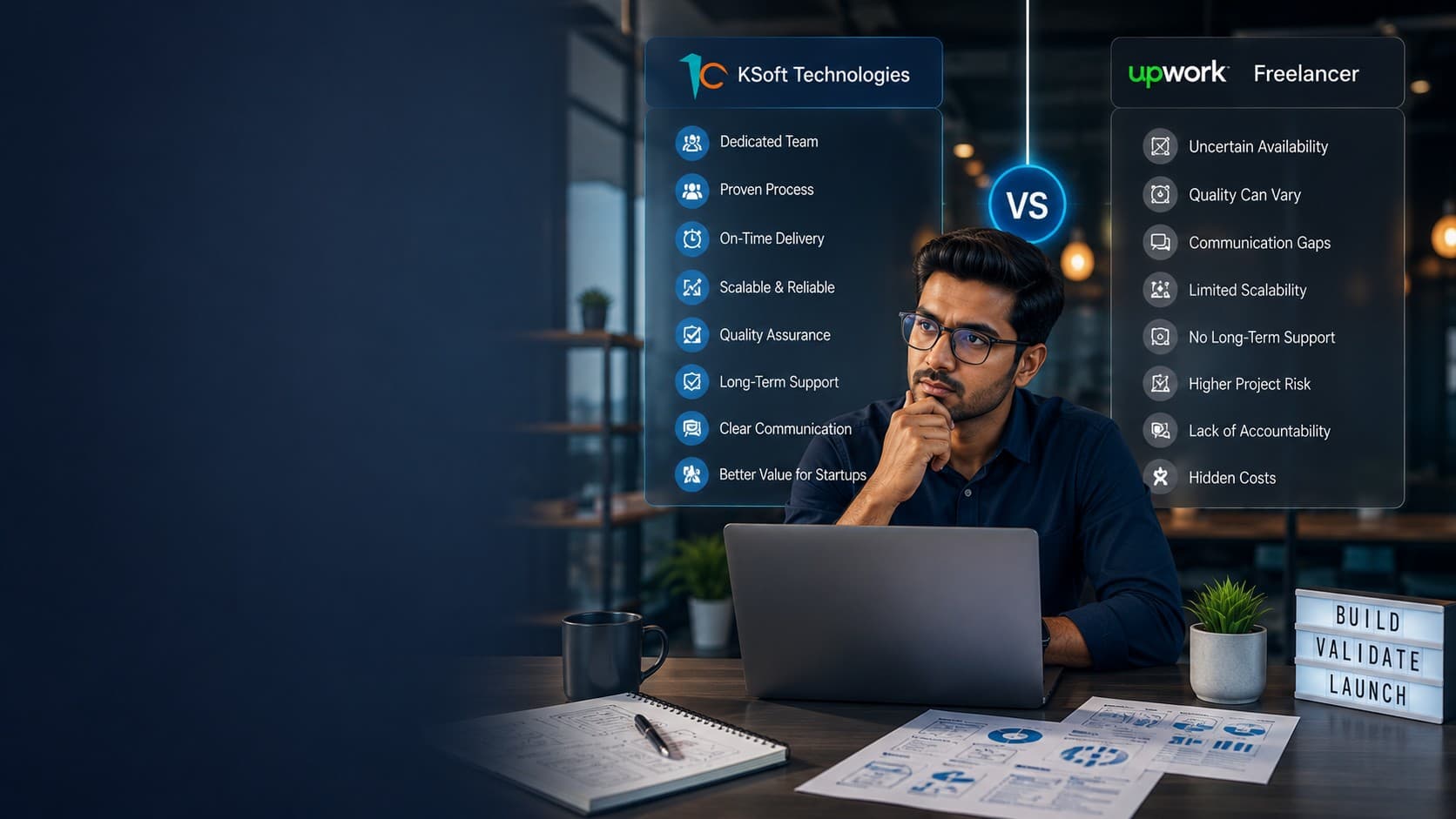
A founder has an idea. The first version needs to be built. The budget is limited. The timeline is tight. The pressure is real. Then comes the decision: Should you hire an Upwork freelancer, or work with a professional software development company like KSoft Technologies? At first, the freelancer route looks simple. You post a job, compare hourly rates, check profiles, and start quickly. For small tasks, this can work very well. But building a startup MVP or a full software product is not always a small task. It usually needs product thinking, UI/UX, frontend, backend, database planning, testing, deployment, bug fixing, documentation, and support after launch. That is where the comparison becomes deeper than cost. The real question is not “Which option is cheaper?” The better question is: Which option gives your startup the best chance of launching a stable, usable, scalable product without unnecessary risk? KSoft Technologies is a structured software development company that provides strategy, design, development, testing, deployment, and support through a team-based process. An Upwork freelancer is an independent professional hired for specific tasks or projects, usually managed directly by the founder or business owner. Both options can be useful. The right choice depends on product complexity, founder experience, technical risk, timeline, and the level of accountability required. The difference is not that one is always good and the other is always risky. The difference is structure. A freelancer is often best for defined tasks. A company is often better for complete product delivery. Before hiring anyone, define your product scope, must-have features, technical risk, timeline, and support expectations. Clarity prevents expensive rework.What Is the Difference Between KSoft and an Upwork Freelancer?
What KSoft typically provides
What an Upwork freelancer typically provides
Need Help Choosing the Right MVP Build Path?
KSoft is usually better for complete MVPs, complex software products, non-technical founders, and long-term support. Upwork freelancers are usually better for small tasks, isolated features, prototypes, bug fixes, or founder-managed projects with very clear requirements. Hiring an Upwork freelancer makes sense when the project is small, clearly defined, easy to review, and does not require a full product team. Freelancers are useful for landing pages, bug fixes, UI updates, integrations, prototypes, and isolated development tasks. Upwork can be a strong option when a founder already knows exactly what needs to be built. If you need a payment gateway integration, a dashboard update, a design fix, or a single feature, a freelancer can be efficient. The key is clarity. The smaller and clearer the task, the better the freelancer model works. Freelancers work best when someone on your side can review code quality, architecture, security, and maintainability. If the founder or CTO can manage delivery, freelancer risk becomes lower. For founders who need temporary development bandwidth, Upwork can be practical. You can hire quickly, test a freelancer, and continue only if the work quality is strong. Upwork freelancers can become risky when the startup needs full product ownership, unclear scope, multiple skill sets, QA, deployment, documentation, and post-launch support. The biggest risk is not hiring a freelancer. The biggest risk is expecting one person to perform like a full product team. If the freelancer disappears, becomes unavailable, or changes priorities, the startup may be stuck. For a small task, this is manageable. For a full MVP, it can delay launch and create technical uncertainty. Many non-technical founders underestimate how much management software development requires. They must define scope, review progress, test features, manage deadlines, clarify requirements, and ensure the product works correctly. If the founder does not have technical experience, this becomes stressful. Upwork has excellent freelancers. It also has freelancers who may be less reliable or less experienced. Reviews and portfolios help, but they do not always reveal architecture quality, documentation habits, security thinking, or long-term maintainability. MVP launch is not the end. It is the beginning of feedback, bug fixes, user requests, performance checks, and product improvements. If the freelancer is unavailable after launch, the founder may need to hire someone else to understand and repair the codebase.Quick Comparison: KSoft vs Upwork Freelancer
Factor KSoft Technologies Upwork Freelancer Best for Complete MVP and software product delivery Small tasks, fixes, prototypes, specific modules Project management Structured process and team coordination Founder usually manages directly Cost Higher upfront but more predictable for full delivery Lower upfront but risk of rework or delays Speed Fast when scope is clear and team is assigned Fast for small tasks, variable for large builds Accountability Company-level accountability Individual-level accountability Technical expertise Multi-skill team across design, backend, frontend, QA Depends on the individual freelancer Support Post-launch support and future roadmap possible Depends on freelancer availability Risk Lower single-person dependency Higher dependency on one individual When Does Hiring an Upwork Freelancer Make Sense?
1. You have a small technical task
2. You have technical review support
3. You want flexible short-term help
Where Upwork Freelancers Can Become Risky for MVP Builds
1. Single-person dependency
2. Founder becomes the project manager
3. Quality varies widely
4. Post-launch support is uncertain
The cheapest developer can become expensive if the product needs to be rebuilt, fixed, or rescued later.
KSoft Technologies makes more sense when the startup needs a complete MVP or software product with clear scoping, product thinking, UI/UX, development, QA, deployment, and support. This is especially useful for non-technical founders and startups building business-critical products. A startup MVP needs more than development. It needs the right scope, user journey, interface, backend logic, testing, deployment, and feedback readiness. A company-level team can connect these pieces into one delivery process. With a development company, the responsibility does not depend only on one freelancer’s availability. A team structure can provide continuity, backup resources, review processes, and better delivery stability. Founders often need help deciding what not to build. KSoft’s MVP content consistently emphasizes lean product scope, fast validation, NDA-first discovery, and helping non-technical founders move from idea to working product with clearer timelines. After launch, startups usually need bug fixes, small improvements, analytics, user feedback changes, infrastructure support, and version-two planning. A structured development partner is usually better suited for that continuity. Upwork freelancers may cost less upfront, especially for small tasks. KSoft may require a higher initial project budget but can reduce hidden costs related to poor planning, rework, missed testing, weak documentation, lack of support, or incomplete product delivery. The real comparison should include total cost of execution, not just hourly price. If your product needs design, development, testing, deployment, and founder-friendly guidance, a structured MVP team can reduce rework and launch confusion.
When Does KSoft Technologies Make More Sense?
1. You need a complete product, not just code
2. You want accountability beyond one individual
3. You need startup-specific guidance
4. You care about post-launch support
Cost Comparison: KSoft vs Upwork Freelancer
Freelancer cost factors
KSoft cost factors
Build Your MVP With Less Delivery Risk
Upwork freelancers can be faster for small tasks. KSoft can be faster for full MVP delivery because the team, process, design, development, testing, and deployment support are coordinated together. Speed depends on scope clarity and decision-making. A freelancer may start quickly, but full product delivery can slow down if the founder needs to hire additional people for design, QA, backend, frontend, deployment, and project management. A company may need more structured onboarding, but once scope is clear, the product can move through a defined execution path. Product quality depends on much more than coding ability. A strong MVP needs clean architecture, simple UX, reliable backend logic, testing, deployment planning, and a product scope that matches user needs. Some freelancers are excellent. They communicate well, write clean code, document properly, and support the product after launch. Others may complete tasks quickly but leave behind unclear code, weak testing, or technical debt. A development company should provide review systems, QA, team collaboration, project management, and documented handover. This does not mean every company is automatically better. It means founders should evaluate process, not only price. Communication is one of the biggest differences between hiring a freelancer and working with a development company. With a freelancer, communication is direct. That can be fast and efficient. But it also means the founder must manage everything. With a company, communication is usually more structured. There may be discovery calls, requirement documents, timelines, milestones, review meetings, and delivery checkpoints. For non-technical founders, that structure can be valuable. KSoft is usually better for startups that need long-term product support, future modules, scalable architecture, documentation, and version-two planning. Freelancers can also provide long-term support, but availability and continuity depend on the individual. A startup MVP should not be over-engineered. But it should not be disposable either. Founders should confirm: Imagine a non-technical founder building a SaaS product for small coaching institutes. The MVP needs student registration, fee tracking, class scheduling, admin login, reminders, and reporting. Hiring one freelancer may look affordable. But the founder soon realizes the product also needs UI/UX, backend logic, database design, testing, deployment, and support. If the founder can manage all of this and has technical review support, Upwork may work. If the founder needs guidance, scope clarity, structured delivery, and long-term support, KSoft may be the safer choice. The right decision depends on how much execution responsibility the founder can realistically carry. Choose KSoft when your startup needs complete MVP delivery, product guidance, team accountability, QA, deployment, and long-term support. Choose an Upwork freelancer when the task is small, well-defined, low-risk, and easy for you to manage directly. For small, isolated tasks, an Upwork freelancer can be a smart and affordable choice. For a complete startup MVP or serious software product, KSoft Technologies is usually the safer option because it offers structured delivery, multi-skill expertise, accountability, QA, deployment, and post-launch support. Founders should not choose based only on the lowest quote. They should choose based on risk, complexity, support needs, and the importance of the product to the business. If your product is a side experiment, a freelancer may be enough. If your product is the foundation of your startup, business, or SaaS company, a structured development partner can reduce risk and improve the chance of launching well. If you are comparing freelancers, agencies, and software development companies, start with a clear MVP scope. KSoft Technologies can help you define what to build first and how to launch with less risk.Speed Comparison: Which Option Launches Faster?
Quality Comparison: Code, UX, Testing, and Product Thinking
Freelancer quality depends on the individual
Company quality depends on process
Communication and Accountability: Who Owns the Outcome?
Scalability and Long-Term Support
A Real-World Startup Scenario
Decision Framework: KSoft or Upwork Freelancer?
Choose KSoft if:
Choose an Upwork freelancer if:
Final Verdict: What’s Better for Startup MVP & Software Development?
Ready to Build Your Startup MVP With More Clarity?
KSoft is usually better when startups need structured MVP scoping, design, development, testing, project management, accountability, and post-launch support. An Upwork freelancer may be better for small, well-defined tasks, quick fixes, prototypes, or founder-managed development work. An Upwork freelancer may look cheaper upfront because hourly rates can be lower. However, founders should also consider project management time, quality checks, communication gaps, rework, missed deadlines, support limitations, and the cost of replacing a freelancer if the project stalls. Startups should hire an Upwork freelancer when the task is small, clearly documented, technically isolated, and easy to review. Freelancers work well for UI fixes, landing pages, bug fixes, integrations, prototypes, and tasks where the founder can manage quality and delivery directly. Startups should choose KSoft Technologies when they need a complete MVP or software product with discovery, planning, UI/UX, frontend, backend, QA, deployment, and post-launch support. This is especially useful for non-technical founders who need product guidance and execution clarity. Yes, experienced freelancers can build scalable MVPs, but quality depends heavily on the individual’s skill, architecture experience, documentation habits, and reliability. Startups should review portfolio, code ownership, deployment process, communication, and maintenance support before hiring. Common risks include inconsistent communication, limited availability, unclear accountability, weak documentation, missed deadlines, quality issues, lack of QA, and limited post-launch support. These risks can be managed with clear scope, milestones, contracts, code reviews, and strong founder involvement. A software development company usually provides a full team, structured process, project management, quality assurance, backup resources, documentation, security practices, and post-launch support. This reduces dependency on one individual and improves reliability for larger or business-critical products. Non-technical founders often benefit from hiring a development company because they need help with product scope, technical decisions, architecture, QA, deployment, and long-term roadmap planning. Freelancers can work well if the founder has clear requirements and technical review support. Startups should compare KSoft and Upwork freelancers based on project size, technical complexity, budget, speed, quality expectations, communication needs, project management capacity, post-launch support, and long-term product roadmap. The best choice depends on risk tolerance and execution needs. A development company is usually better for long-term software development when the product needs continuous improvement, support, security, scalability, QA, and roadmap planning. Freelancers can support long-term work too, but availability and dependency risks should be managed carefully. Frequently Asked Questions
Is KSoft better than hiring an Upwork freelancer for MVP development?
Is an Upwork freelancer cheaper than KSoft?
When should startups hire an Upwork freelancer?
When should startups choose KSoft Technologies?
Can freelancers build scalable MVPs?
What are the risks of hiring an Upwork freelancer for software development?
What are the advantages of a software development company over a freelancer?
Should non-technical founders hire freelancers or a company?
How should startups compare KSoft and Upwork, freelancers?
Which option is better for long-term software development?