Imagine spending nine months building a product, hiring developers, investing thousands of dollars, and finally launching to the market—only to discover that customers never had the problem you were trying to solve.
This isn't an uncommon startup story. Many founders move directly into MVP development believing speed is everything. They build quickly, launch quickly, and unfortunately learn expensive lessons that could have been avoided through a structured product discovery process.
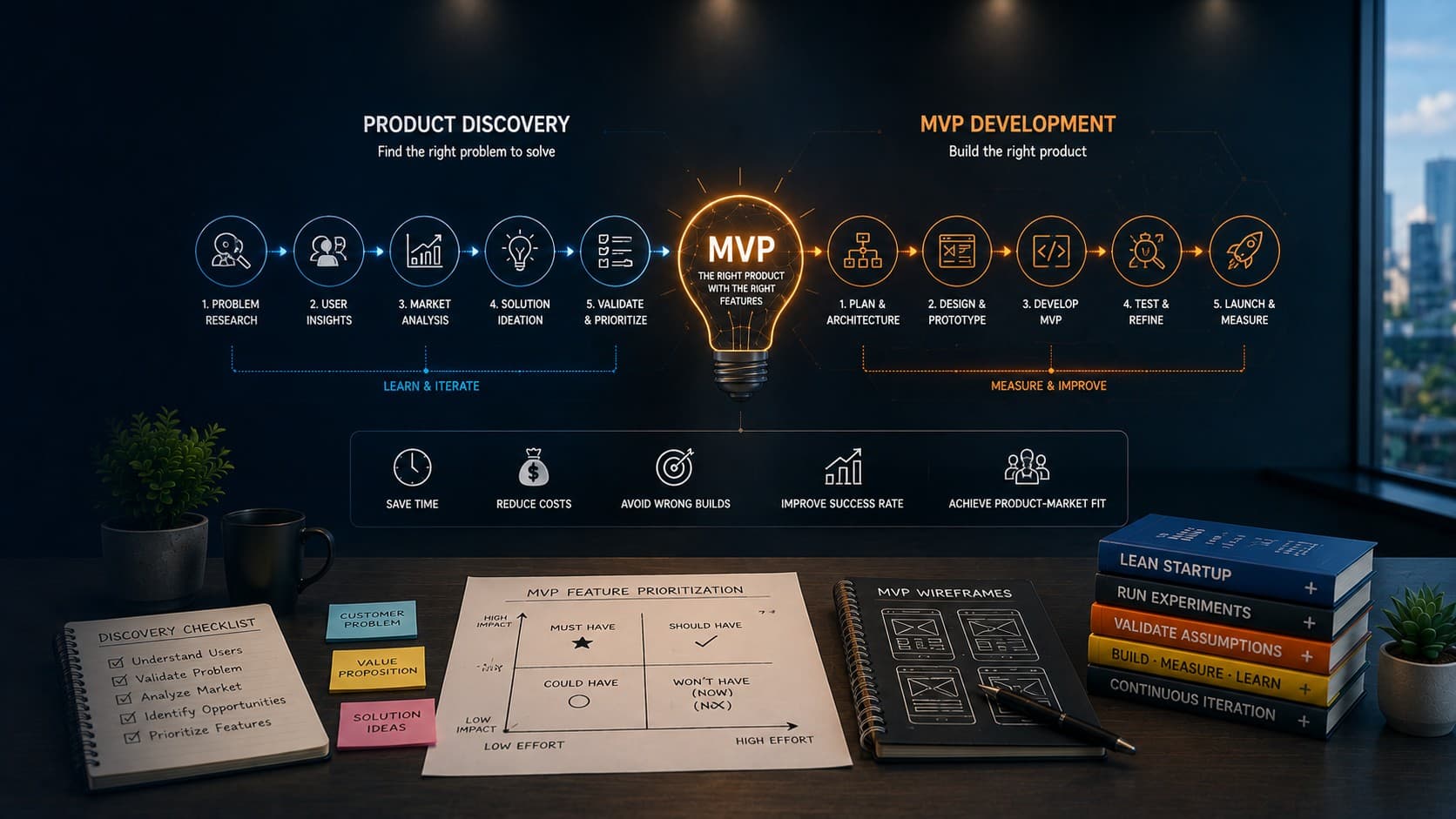
While MVP development validates whether customers will use your solution, product discovery validates whether you're solving the right problem in the first place. Together, these two disciplines dramatically reduce product risk, improve development efficiency, and increase the likelihood of achieving product-market fit.
According to CB Insights, "no market need" continues to rank among the leading reasons startups fail—highlighting why validating customer problems before development remains essential.
What Is Product Discovery?
Product discovery is the strategic process of understanding customer problems, validating business assumptions, researching competitors, defining product goals, and identifying the smallest possible solution that delivers meaningful customer value.
Instead of immediately discussing features or technologies, product discovery focuses on answering several critical business questions before software development begins.
A typical product discovery process includes:
- Customer interviews
- Problem validation
- User research
- Market analysis
- Competitor research
- User persona creation
- Business model evaluation
- Feature prioritization
- Product roadmap planning
The objective is simple: reduce uncertainty before investing heavily in product development.
What Is MVP Development?
Once product discovery confirms that a real customer problem exists, MVP development transforms those insights into a working software product that can be released to early users.
An MVP—or Minimum Viable Product—is not a smaller version of the final application. Instead, it is the first version that contains only the essential functionality needed to validate the product idea in the real market.
An effective MVP focuses on:
- Core customer problem
- Essential functionality only
- Rapid market validation
- User feedback collection
- Measuring product adoption
- Iterative improvement
- Reducing development investment
- Accelerating product learning
The goal isn't to build everything. It's to learn as much as possible with the smallest practical investment.
Why Startups Often Confuse These Two Stages
One of the most common startup mistakes is assuming product discovery and MVP development are interchangeable. They're not.
Product discovery happens before development begins. It validates the business opportunity, customer pain points, and product direction. MVP development comes afterward and focuses on validating the proposed solution through a functional product.
Skipping discovery often results in oversized MVPs, changing requirements, delayed launches, and unnecessary development costs because teams begin solving problems they haven't fully understood.
Validate Your MVP Before You Build
The earlier you validate your product assumptions, the less you'll spend fixing expensive mistakes later.
Plan Your MVP →Product Discovery Answers "Should We Build It?"
Every successful software product begins with a simple question:
Are we solving a problem people actually care about?
That question sits at the heart of product discovery. Before discussing programming languages, UI designs, or development estimates, founders need confidence that their idea addresses a genuine market need.
Product discovery minimizes assumptions by replacing opinions with research. Through customer conversations, market analysis, and validation exercises, founders gain a clearer understanding of the opportunity before investing significant resources.
During Product Discovery, Teams Typically Validate:
- The primary customer pain point
- Who the ideal users are
- Current alternatives customers already use
- Market demand
- Revenue opportunities
- Competitive positioning
- Business viability
- Feature priorities
Without this foundation, development teams often build products around assumptions rather than evidence.
Product discovery isn't about proving your idea is right. It's about discovering whether your assumptions are accurate before development begins.
MVP Development Answers "Can We Solve It?"
Once product discovery confirms the business opportunity, the next objective is validating the solution itself. This is where MVP development begins.
Rather than creating a complete software platform, development focuses on delivering the smallest usable product capable of solving one clearly defined customer problem.
A Well-Planned MVP Helps Startups:
- Launch faster
- Reduce development costs
- Collect customer feedback
- Measure user behavior
- Validate pricing assumptions
- Reduce technical risk
- Identify improvement opportunities
- Support future product iterations
Instead of waiting until dozens of features are complete, founders begin learning from real customers as early as possible.
How Product Discovery and MVP Development Work Together
These two processes should never compete with each other. They solve different problems at different stages of the startup journey.
Product discovery reduces business risk by ensuring the startup builds the right solution. MVP development reduces product risk by testing whether that solution performs successfully in the real market.
| Product Discovery | MVP Development |
|---|---|
| Validates customer problems | Validates the product solution |
| Research driven | Development driven |
| Occurs before coding | Occurs after discovery |
| Focuses on business strategy | Focuses on product execution |
| Reduces business uncertainty | Reduces product uncertainty |
| Creates product roadmap | Builds working software |
When both stages are completed in sequence, startups dramatically improve their chances of launching products that customers actually want.
What Happens During a Product Discovery Workshop?
Many founders assume product discovery is simply a brainstorming session. In reality, it's a structured framework designed to answer the most important business questions before development starts.
Rather than discussing features immediately, the focus is on understanding customers, validating assumptions, identifying opportunities, and defining measurable product goals.
A Typical Product Discovery Workshop Covers:
- Business vision and long-term objectives
- Target customer identification
- Problem statement validation
- Customer journey mapping
- Competitor benchmarking
- User personas
- Feature prioritization
- Business model analysis
- Success metrics and KPIs
- Initial product roadmap creation
By the end of discovery, founders have far more than an idea—they have a strategic blueprint that guides every future product decision.
The purpose of discovery isn't to create documentation. It's to reduce uncertainty so development can move faster with greater confidence.
Common Startup Mistakes When Discovery Is Skipped
Many startups believe skipping discovery saves time. In reality, it usually delays success because problems emerge during development rather than before it.
Without proper validation, development teams frequently build features customers never requested, redesign workflows midway through the project, or completely rethink the product after launch.
Typical Consequences Include:
- Uncontrolled feature expansion
- Frequent requirement changes
- Longer development timelines
- Higher engineering costs
- Poor product-market fit
- Low customer adoption
- Technical rework
- Reduced investor confidence
These issues rarely result from poor engineering—they're usually symptoms of insufficient product planning.
How Discovery Helps Control MVP Development Costs
Every feature added to an MVP increases design effort, development time, testing, documentation, maintenance, and future support requirements. Product discovery helps founders identify which features create immediate customer value and which can safely wait for future releases.
Instead of attempting to build a complete platform on day one, discovery encourages startups to launch a focused solution capable of validating one core business hypothesis.
Discovery Helps Reduce Costs By:
- Removing unnecessary features before development
- Preventing expensive scope changes
- Improving development estimates
- Prioritizing high-impact functionality
- Reducing technical debt
- Improving sprint planning
- Accelerating time-to-market
- Minimizing redevelopment after launch
This disciplined approach enables startups to spend their development budget where it creates the greatest return instead of dispersing resources across low-priority functionality.
Scope Your MVP the Right Way
Successful products begin with clear product discovery and disciplined MVP planning. Validate your assumptions before investing months in development.
Why Customer Validation Is the Missing Link Between Discovery and MVP
Many founders assume that if they understand the problem, they're ready to build. However, understanding a problem internally is very different from validating it with real customers.
Customer validation bridges the gap between product discovery and MVP development. It confirms that the identified problem is significant enough for customers to adopt—or even pay for—a solution.
This stage reduces one of the biggest startup risks: building software that nobody truly needs.
Common Customer Validation Techniques
- One-on-one customer interviews
- Problem discovery workshops
- Clickable prototypes
- Landing page experiments
- Email waitlists
- Surveys and questionnaires
- Competitor review analysis
- Early adopter communities
Validation doesn't require a finished application. In many cases, founders can gain meaningful insights before a single line of production code is written.
The purpose of customer validation isn't to prove your startup idea is perfect—it's to discover what needs to change before expensive development begins.
The Role of Product Discovery in Building Investor Confidence
Investors understand that startups operate with uncertainty. What gives them confidence isn't certainty—it's a founder's ability to reduce uncertainty through structured decision-making.
A strong product discovery process demonstrates that the founding team has invested time in understanding customers, validating assumptions, and planning execution rather than relying solely on intuition.
Discovery Creates Investor-Ready Documentation
- Customer personas
- Market validation findings
- Competitive landscape analysis
- Problem-solution fit documentation
- Feature prioritization framework
- MVP scope definition
- Development roadmap
- Budget estimates
- Business assumptions
- Go-to-market considerations
These deliverables help founders communicate a clearer vision while demonstrating that product decisions are supported by research rather than assumptions.
How KSoft Technologies Approaches Product Discovery
At KSoft Technologies, we've worked with startups that initially believed they needed dozens of features before launch. In many cases, structured discovery revealed that only a small subset of functionality was necessary to validate the business idea successfully.
Our approach focuses on helping founders understand customer problems, prioritize product capabilities, define realistic MVP scopes, and select technologies that support long-term scalability rather than short-term trends.
Instead of treating discovery as documentation, we treat it as a decision-making framework that improves every stage of product development.
Build Your MVP on the Right Foundation
Every successful software product starts with understanding customers before writing code. Let our team help you validate your idea, define the right MVP, and create a roadmap built for long-term success.
Choosing the Right Technology After Product Discovery
Technology decisions should never come before product discovery. Once founders clearly understand their customers, product goals, and MVP scope, selecting the right technology becomes much easier.
Instead of choosing frameworks based on popularity, startups should evaluate technologies according to scalability, development speed, maintenance requirements, security, integration capabilities, and long-term business objectives.
Important Technology Considerations Include:
- Expected user growth
- Cloud infrastructure requirements
- Third-party integrations
- API architecture
- Mobile and web platform support
- Security and compliance needs
- Development timeline
- Long-term maintenance costs
The right technology stack supports rapid MVP delivery today while allowing the product to evolve as customer demand increases.
Technology should support the business strategy—not define it. The best architecture is the one that helps your startup learn, iterate, and scale efficiently.
What Deliverables Should Come Out of Product Discovery?
A successful discovery phase ends with actionable outputs that guide the entire development lifecycle. These deliverables provide alignment between founders, designers, developers, investors, and stakeholders.
Typical Product Discovery Deliverables
- Business objectives documentation
- Validated problem statements
- Customer personas
- User journey maps
- Competitor research
- Feature prioritization matrix
- MVP scope document
- Product requirement specification (PRD)
- Technical architecture recommendations
- Development roadmap
- Timeline estimates
- Budget projections
These documents become the blueprint that keeps development focused, minimizes ambiguity, and reduces costly mid-project changes.
Discovery Doesn't Delay Launch—It Accelerates It
Some founders worry that investing time in product discovery will postpone development. In reality, discovery often shortens the overall project timeline because it eliminates uncertainty before engineering begins.
When teams understand exactly what needs to be built, developers spend less time clarifying requirements, redesigning workflows, and rebuilding completed features.
Benefits of Investing in Discovery First
- More accurate development estimates
- Better sprint planning
- Fewer scope changes
- Improved collaboration between business and technical teams
- Reduced product risk
- Higher development productivity
- Faster market validation
- Greater confidence throughout the project
Rather than slowing progress, product discovery creates the clarity that enables startups to move faster with fewer setbacks.
Validate Your Product Before You Invest in Development
Whether you're building your first SaaS platform or launching your next startup, combining product discovery with disciplined MVP development can dramatically improve your chances of success.
Talk to a Product Strategy ExpertExplore MVP Development ServicesProduct Discovery Helps Build Better Teams, Not Just Better Products
One overlooked benefit of product discovery is the alignment it creates across the entire team. Founders, designers, developers, marketers, and stakeholders begin working toward the same vision because everyone understands the customer problem, business objectives, and product priorities.
Without this shared understanding, development teams often interpret requirements differently, resulting in inconsistent user experiences, unnecessary revisions, and avoidable delays.
Product Discovery Improves Team Alignment By:
- Establishing a shared product vision
- Clarifying business objectives
- Creating measurable product goals
- Reducing communication gaps
- Improving cross-functional collaboration
- Defining realistic project milestones
- Helping teams prioritize customer value
- Supporting faster decision-making
When everyone understands why a product is being built—not just what is being built—execution becomes significantly more efficient.
Great software teams don't simply build features. They solve customer problems together with a shared understanding of business goals.
When Should Startups Begin Product Discovery?
The ideal time to begin product discovery is before hiring developers or investing in software development. Every strategic decision made during discovery has the potential to reduce future costs and improve product outcomes.
However, startups that are already building a product can also benefit. Discovery workshops often help teams reassess priorities, simplify MVP scope, and identify opportunities to improve product-market fit before investing further.
You Should Consider Product Discovery If:
- You have an idea but no structured roadmap.
- Your feature list continues to grow.
- Your team disagrees on priorities.
- You're unsure who your primary customer is.
- Development estimates keep increasing.
- You're preparing for investor meetings.
- You want to reduce product risk.
- You're planning a SaaS platform or custom software product.
Discovery isn't reserved for large enterprises. It provides value for startups at every stage by replacing uncertainty with informed decision-making.
Why Discovery and MVP Development Create a Competitive Advantage
Markets evolve quickly, customer expectations change, and competitors continue to innovate. Startups that combine structured discovery with disciplined MVP development respond to these changes more effectively because their decisions are driven by evidence rather than assumptions.
Instead of investing heavily in large product releases, they learn continuously, release incrementally, and improve based on measurable customer feedback.
This Approach Helps Startups:
- Reach the market faster
- Reduce development waste
- Increase customer satisfaction
- Improve feature adoption
- Strengthen product-market fit
- Scale with greater confidence
- Use budgets more efficiently
- Adapt quickly to changing customer needs
In today's competitive software landscape, learning faster than competitors often creates a greater advantage than simply building faster.
Build Your Product With Confidence
A successful product begins with understanding your customers, validating your assumptions, and defining the right MVP. Our team helps startups transform ideas into practical product roadmaps that reduce risk and accelerate growth.
Book a Product Discovery SessionLearn About MVP DevelopmentReal-World Scenario: Discovery First, Development Second
Imagine two startups with the same software idea and similar budgets.
The first startup immediately hires developers and begins building a large feature set based on internal assumptions. Every few weeks, requirements change as the founders rethink priorities and discover new ideas.
The second startup spends a few weeks on product discovery. They interview potential customers, study competitors, define the core problem, prioritize essential features, and create a realistic MVP roadmap before writing any code.
Six months later, the outcomes look very different.
The first startup is still developing. Costs have increased, timelines have slipped, and the team is rebuilding several completed features.
The second startup has already launched an MVP, collected customer feedback, and is planning the next release based on actual user behavior instead of assumptions.
The difference wasn't engineering talent.
It was the quality of decisions made before development started.
The startups that win aren't always the ones that build the fastest—they're the ones that learn the fastest.
How KSoft Technologies Helps Startups Build Better Products
At KSoft Technologies, we believe successful software starts long before development begins. Every engagement focuses on understanding the business problem, validating customer needs, defining a realistic MVP scope, and selecting technologies that support long-term scalability.
Rather than treating product discovery as a documentation exercise, we use it as a strategic decision-making process that aligns founders, designers, developers, and stakeholders around a shared vision.
Whether you're building a SaaS platform, marketplace, enterprise application, or AI-powered solution, combining structured discovery with disciplined MVP development creates a stronger foundation for sustainable growth.
Final Thoughts
Product discovery and MVP development aren't competing approaches—they're complementary stages of a successful product journey.
Discovery ensures you're solving the right problem.
MVP development ensures you're solving it in the right way.
Skipping either stage increases uncertainty, wastes valuable development resources, and makes achieving product-market fit significantly more difficult.
Founders who invest time in understanding customers before building software consistently make better product decisions, control development costs more effectively, and launch with greater confidence.
The best products don't begin with code.
They begin with clarity.
Turn Your Product Idea Into a Market-Ready MVP
From product discovery and validation to MVP planning and software development, KSoft Technologies helps startups reduce risk and build products customers truly want.
Frequently Asked Questions
1. What is product discovery?
Product discovery is a structured process that helps startups validate customer problems, understand market demand, prioritize features, and define a product strategy before software development begins.
2. What is MVP development?
MVP (Minimum Viable Product) development focuses on building the smallest functional version of a product that solves a core customer problem and allows startups to validate their solution using real user feedback.
3. What is the difference between product discovery and MVP development?
Product discovery determines what should be built and why, while MVP development focuses on building the validated solution. Discovery reduces business risk, whereas MVP development reduces product risk.
4. Why should startups perform product discovery before development?
Product discovery helps founders validate assumptions, understand customer needs, reduce unnecessary features, improve product-market fit, and avoid expensive development mistakes before investing significant time and money.
5. How long does a product discovery phase usually take?
Depending on the product complexity, discovery typically takes between two and six weeks. The outcome is a clear product strategy, validated requirements, and a roadmap for efficient MVP development.
6. Can product discovery reduce development costs?
Yes. By identifying unnecessary functionality early, prioritizing essential features, and validating customer needs, product discovery often reduces development costs, shortens timelines, and minimizes expensive rework.
7. Who should participate in a product discovery workshop?
Founders, product managers, business stakeholders, designers, technical architects, and key decision-makers should participate. Including different perspectives helps create a product strategy that aligns business objectives with customer expectations.
8. Can an existing startup benefit from product discovery?
Absolutely. Even startups with products already under development can use product discovery to reassess priorities, simplify the MVP, improve customer alignment, and strengthen long-term product strategy.
9. What deliverables should I expect from a product discovery process?
A comprehensive product discovery engagement typically includes customer personas, validated problem statements, competitor analysis, user journey maps, feature prioritization, MVP scope documentation, technical recommendations, product roadmaps, timeline estimates, and budget planning.
10. Is product discovery only for SaaS startups?
No. Product discovery benefits SaaS startups, marketplaces, mobile applications, enterprise software, AI products, healthcare platforms, fintech solutions, and virtually any digital product that requires customer validation before development.
11. How do I know if my startup needs product discovery?
If your team is uncertain about customer needs, product features, development priorities, market demand, or technology decisions, product discovery can provide the clarity needed before committing significant development resources.
12. How do I choose the right product discovery partner?
Look for a partner with proven experience in startup consulting, product strategy, UX research, MVP planning, software architecture, agile development, and customer validation. A structured discovery methodology and a strong portfolio of successful digital products are also important indicators.