Many startups don't fail because their developers write poor code—they fail because they build the wrong product. Founders often rush into development with exciting ideas but without validating customer demand, defining a focused feature set, or establishing a realistic product roadmap. By the time they realize something is wrong, significant time and budget have already been spent.
This is where MVP consulting creates tremendous value. Rather than jumping straight into development, experienced consultants help founders validate business ideas, identify their ideal users, prioritize features, reduce technical risk, and create a practical roadmap that aligns product development with real market needs.
Whether you're a first-time entrepreneur or an experienced founder launching your next SaaS product, investing in expert guidance before writing code can dramatically improve your chances of building a successful product while avoiding unnecessary costs and delays.
CB Insights consistently reports that one of the leading reasons startups fail is building products that lack sufficient market demand—highlighting the importance of validation before development begins.
What Is MVP Consulting?
MVP consulting is a structured product strategy process that helps founders transform an early-stage business idea into a validated, development-ready Minimum Viable Product (MVP). Instead of focusing solely on technology, MVP consultants evaluate the business problem, customer needs, product positioning, feature priorities, technical architecture, and launch strategy to reduce uncertainty before development starts.
The objective isn't simply to build software quickly—it's to build the right software with the smallest investment necessary to validate the business idea.
A typical MVP consulting engagement includes:
- Startup idea validation
- Customer and market research
- Competitor analysis
- Feature prioritization
- MVP scope definition
- Technology recommendations
- Development roadmap planning
- Budget estimation
- Risk assessment
Why Founders Skip Consulting—and Why It Often Costs More
Many founders believe they can save money by moving directly into development. Unfortunately, this approach often leads to oversized MVPs, unclear requirements, changing priorities, and expensive rework after development has already begun.
Without a clear product strategy, development teams frequently build features based on assumptions rather than validated customer needs. This increases complexity, extends timelines, and consumes budgets without improving the product's likelihood of success.
Common problems caused by skipping MVP consulting:
- Overbuilt first versions
- Unclear product requirements
- Frequent scope changes
- Poor feature prioritization
- Higher development costs
- Delayed product launches
- Reduced investor confidence
- Weak product-market fit
Validate Your MVP Before You Build
The right product strategy can save months of development time and thousands in unnecessary engineering costs.
Plan Your MVP →How MVP Consulting Reduces Startup Risk
Every startup begins with uncertainty. Founders rarely know exactly which features customers will use, how users will behave, or what pricing model will work best. MVP consulting is designed to reduce this uncertainty before significant development resources are committed.
Rather than relying on assumptions, consultants help founders validate ideas using structured discovery sessions, customer interviews, competitor research, and business model analysis. The result is a product roadmap based on evidence rather than intuition.
Major risks reduced through MVP consulting include:
- Building features customers don't need
- Launching with an unclear value proposition
- Overspending on unnecessary development
- Selecting an unsuitable technology stack
- Poor scalability planning
- Delays caused by changing requirements
- Weak investor confidence due to lack of product clarity
Instead of guessing what customers might want, founders gain a structured approach for validating ideas before development begins.
Harvard Business Review has consistently emphasized that disciplined experimentation and customer validation significantly improve innovation outcomes compared to assumption-driven product development.
What Happens During an MVP Consulting Engagement?
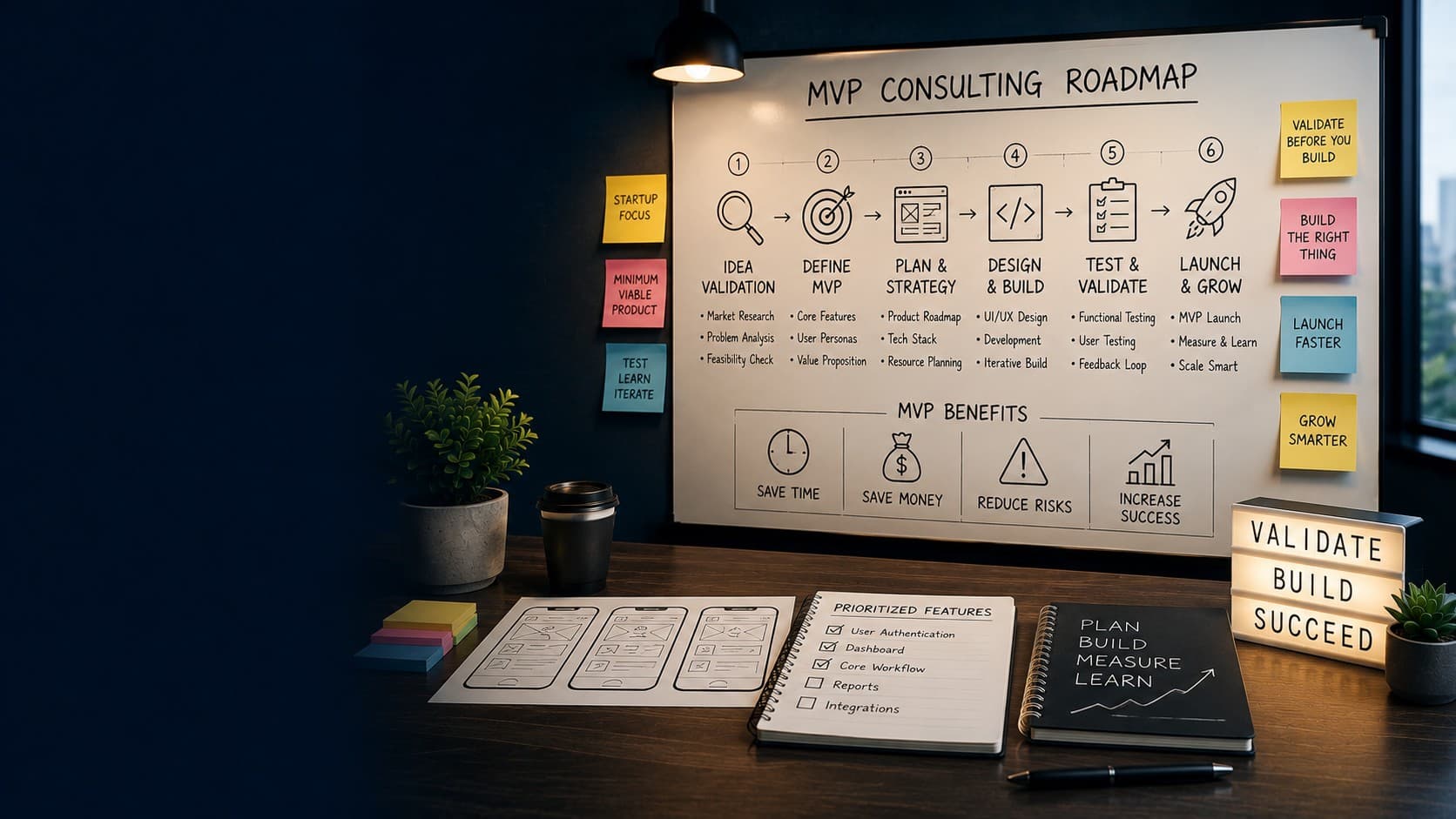
An effective consulting engagement is much more than a brainstorming session. It follows a structured process that gradually transforms an idea into a development-ready product strategy.
Step 1 — Understanding the Business Vision
The consultant works closely with founders to understand the business idea, target audience, revenue model, competitive landscape, and long-term goals. This establishes the strategic direction for the product.
Step 2 — Market Validation
The proposed solution is evaluated against existing market demand. This may involve competitor analysis, customer interviews, industry research, and identifying underserved opportunities within the market.
Step 3 — Feature Prioritization
Rather than attempting to build everything at once, features are categorized into essentials and future enhancements. This ensures the MVP remains focused on validating the core business hypothesis.
Step 4 — Technical Planning
Technology choices influence both development speed and long-term scalability. During this stage, consultants recommend suitable architectures, frameworks, cloud infrastructure, APIs, and integration strategies based on the startup's objectives.
Step 5 — Roadmap Creation
Finally, the startup receives a practical development roadmap outlining milestones, timelines, budgets, risks, and launch priorities. This roadmap provides clarity for founders, development teams, and potential investors.
Why Feature Prioritization Matters More Than Feature Quantity
One of the biggest mistakes early-stage founders make is believing that more features create more value. In reality, oversized MVPs often delay launches, increase budgets, and make it harder to gather meaningful user feedback.
A successful MVP solves one important customer problem exceptionally well rather than attempting to satisfy every possible use case.
Questions consultants ask when prioritizing features:
- Does this feature directly validate the business idea?
- Will users immediately benefit from this functionality?
- Can the product launch successfully without it?
- Does it generate measurable customer feedback?
- Will it significantly increase development complexity?
- Can it be introduced in a later release?
This disciplined prioritization process enables startups to reach the market faster while preserving capital for future iterations.
Why Customer Validation Comes Before Product Development
One of the greatest advantages of MVP consulting is that it shifts the focus from assumptions to evidence. Instead of asking, "Can we build this?" founders begin asking, "Should we build this?"
Customer validation doesn't require a finished product. Through interviews, landing pages, surveys, prototype demonstrations, and problem discovery sessions, startups can understand whether people genuinely need the solution before investing heavily in development.
This approach dramatically reduces the risk of launching a product that solves the wrong problem or targets the wrong audience.
Effective validation methods include:
- Customer discovery interviews
- Problem validation surveys
- Clickable product prototypes
- Landing page experiments
- Pre-launch waiting lists
- Competitive product analysis
- Early adopter feedback sessions
- Industry expert interviews
The objective of validation isn't to prove your idea is perfect—it's to identify weaknesses early enough that they can be corrected before development begins.
Choosing the Right Technology Stack Early Saves Future Costs
Technology decisions made during the planning stage have a lasting impact on development speed, scalability, maintenance costs, and future product evolution.
Many founders select technologies based on popularity rather than business requirements. MVP consulting helps align technology choices with the startup's long-term objectives instead of short-term trends.
A consultant typically evaluates:
- Expected user growth
- Budget limitations
- Development timeline
- Required integrations
- Security requirements
- Cloud infrastructure
- Mobile versus web priorities
- Future scalability needs
Choosing the appropriate architecture from the beginning reduces technical debt and minimizes expensive redevelopment later in the product lifecycle.
Build Smarter Before You Build Bigger
A well-defined MVP roadmap helps founders avoid unnecessary development, launch faster, and validate their business idea with confidence instead of assumptions.
Start Your MVP Strategy View Startup Success StoriesHow MVP Consulting Improves Investor Readiness
Investors rarely fund ideas alone—they invest in founders who demonstrate a clear understanding of the market, customers, and execution strategy.
A structured MVP consulting process produces documentation that strengthens investor conversations by replacing vague concepts with measurable plans.
Deliverables that improve funding readiness:
- Validated business assumptions
- Clearly defined target audience
- Feature prioritization matrix
- Product roadmap
- Technical architecture recommendations
- Development timeline estimates
- Budget projections
- Risk mitigation strategy
These artifacts provide confidence that the startup has thoughtfully evaluated both the opportunity and the execution plan before seeking investment.
MVP Consulting vs. Jumping Straight Into Development
| Without MVP Consulting | With MVP Consulting |
|---|---|
| Features based on assumptions | Features based on validated customer needs |
| Frequent scope changes | Clearly defined MVP scope |
| Higher development costs | Controlled development budget |
| Longer launch timelines | Faster MVP releases |
| Higher product risk | Reduced technical and business risk |
| Uncertain investor conversations | Clear product roadmap and execution plan |
Although consulting requires an initial investment, it frequently prevents far larger expenses caused by rebuilding products, changing direction midway through development, or launching features that customers never requested.
Common Startup Mistakes That MVP Consulting Prevents
Many startup founders assume that speed alone determines success. While launching quickly is important, moving in the wrong direction simply means you'll reach the wrong destination faster. MVP consulting helps founders avoid common mistakes that consume time, money, and valuable market opportunities.
Experienced consultants have seen dozens of startup journeys and can identify potential risks before they become expensive development problems.
The Most Common Mistakes Include:
- Trying to solve too many customer problems in the first release.
- Building features based on personal assumptions instead of customer research.
- Ignoring competitor strengths and market positioning.
- Skipping user interviews before development begins.
- Changing requirements repeatedly during development.
- Overengineering the product architecture for an initial launch.
- Choosing technologies without considering long-term scalability.
- Launching without a clear success metric.
Most of these mistakes aren't caused by poor development—they happen because the product strategy wasn't clearly defined before development started.
The best startup founders aren't necessarily the ones who build the fastest. They're the ones who learn the fastest and make informed decisions before investing heavily in product development.
What Deliverables Should Founders Expect From MVP Consulting?
A quality MVP consulting engagement should leave founders with far more than meeting notes. By the end of the process, the startup should have a practical blueprint that guides product development and aligns every stakeholder around the same vision.
Typical Deliverables Include:
- Business and product discovery documentation
- Target audience and user persona definitions
- Problem statement validation
- Competitive analysis report
- Feature prioritization matrix
- MVP scope document
- User journey and workflow diagrams
- Technical architecture recommendations
- Development roadmap
- Budget estimation
- Release planning strategy
- Product growth recommendations
These deliverables reduce ambiguity, improve communication with development teams, and make project execution significantly smoother.
Validate Before You Invest in Development
Building software without a clear product strategy is one of the most expensive mistakes a startup can make. A structured MVP consulting process helps you launch with confidence while keeping development lean and focused.
Book an MVP Consultation Explore SaaS MVP DevelopmentWhen Should You Hire an MVP Consultant?
The earlier an MVP consultant becomes involved, the greater the potential impact. Consulting is particularly valuable before hiring developers or committing to technical decisions because changes are far less expensive during planning than after development has started.
However, startups that are already building a product can also benefit. Many founders engage consultants midway through development when they realize the scope has expanded, priorities have shifted, or customer feedback isn't matching expectations.
Ideal Times to Seek MVP Consulting:
- You have an idea but no product roadmap.
- Your team is unsure which features belong in the MVP.
- Development estimates vary significantly.
- You're preparing to pitch investors.
- You want to validate market demand before investing.
- Your product scope keeps expanding.
- You're planning to build a SaaS platform or marketplace.
- You need an experienced product strategy partner.
The goal isn't simply to reduce development costs. It's to increase the likelihood that every development hour contributes directly to building a successful product.
A Real-World Example: How MVP Consulting Changed the Outcome
Consider a founder with an idea for a B2B workflow automation platform. The original vision included more than 70 features covering project management, invoicing, CRM, HR, analytics, messaging, and AI-powered reporting.
The estimated development timeline exceeded twelve months, and the projected budget was well beyond what the startup could realistically afford.
During the MVP consulting process, the team stepped back and asked a much simpler question:
"What is the single biggest problem our first customers need solved?"
After interviewing potential users, one insight became obvious. Customers weren't asking for an all-in-one platform—they wanted a simpler way to automate project approvals.
That discovery completely changed the product strategy.
Instead of building seventy features, the startup launched with just eight carefully selected capabilities that solved one high-value problem exceptionally well.
The result?
- The development timeline was reduced by nearly 60%.
- The launch budget became manageable.
- The product reached customers months earlier.
- User feedback guided future development instead of assumptions.
- New features were added based on real customer demand.
This is the real value of MVP consulting. It doesn't reduce ambition—it creates focus.
Successful startups rarely build everything first. They learn first, validate first, and then scale with confidence.
Questions Every Founder Should Answer Before Building an MVP
Before hiring developers, founders should be able to answer several strategic questions with confidence. If these answers remain unclear, investing additional time in product discovery is usually far less expensive than correcting mistakes after development begins.
Founder Readiness Checklist
- Who is the ideal customer?
- What problem are we solving?
- Why would customers switch from their current solution?
- Which feature delivers immediate value?
- What assumptions still require validation?
- How will we measure MVP success?
- What feedback will determine the next release?
- How much budget is available for the first version?
- What is our expected timeline?
- What risks could delay launch?
Answering these questions early creates alignment between founders, designers, developers, investors, and future customers.
How MVP Consulting Supports Long-Term Product Growth
The benefits of MVP consulting extend well beyond the initial launch. The roadmap created during discovery becomes a living document that helps guide future product decisions as customer needs evolve.
Instead of making reactive decisions after launch, founders can prioritize improvements based on customer feedback, business goals, and measurable product performance.
Long-Term Advantages Include:
- Clear product evolution strategy
- Better release planning
- Improved technical scalability
- Data-driven feature prioritization
- Lower long-term development costs
- More predictable budgeting
- Stronger investor confidence
- Higher product-market fit over time
This structured approach enables startups to grow intentionally rather than reacting to every new idea or customer request.
Turn Your Startup Idea Into a Focused MVP
Whether you're validating your first startup idea or preparing for development, the right product strategy can dramatically improve your chances of launching a successful software product.
Build Your MVP the Right Way See How Startups Have SucceededWhy Building Less Often Leads to Greater Success
One of the hardest lessons for founders is realizing that saying "no" to features is often more valuable than saying "yes." Every additional feature increases development time, testing effort, maintenance costs, and user complexity.
An MVP should never attempt to satisfy every potential customer. Instead, it should solve one meaningful problem exceptionally well for one clearly defined audience. This focused approach produces faster learning, stronger user engagement, and better product decisions.
Benefits of a Lean MVP
- Faster product launch
- Lower development investment
- Earlier customer feedback
- Reduced technical complexity
- Simpler onboarding experience
- More accurate validation of business assumptions
- Greater flexibility for future iterations
- Lower product maintenance costs
Startups that launch lean products gain valuable market insights months earlier than competitors who spend excessive time building features customers may never use.
A successful MVP isn't defined by how much software it contains. It's defined by how quickly it helps founders learn whether they're solving a real customer problem.
The Relationship Between MVP Consulting and Agile Development
Some founders mistakenly believe MVP consulting slows development. In reality, it complements Agile methodologies by ensuring development teams build the highest-priority functionality first.
Consulting provides strategic direction, while Agile provides an efficient delivery framework. Together, they create a disciplined product development process that balances speed with informed decision-making.
How MVP Consulting Supports Agile Teams
- Clearly prioritized product backlog
- Well-defined user stories
- Reduced sprint interruptions
- Better release planning
- Fewer mid-project scope changes
- Improved stakeholder alignment
- More predictable delivery schedules
- Higher development efficiency
When product strategy is established before development begins, Agile teams spend more time building valuable functionality and less time responding to changing priorities.
Signs Your Startup Needs MVP Consulting Immediately
Not every startup recognizes when outside product guidance can make the biggest difference. If your team is experiencing uncertainty around direction, scope, or customer needs, consulting can provide the clarity required before investing further in development.
You Should Consider MVP Consulting If:
- Your product vision keeps changing.
- You cannot clearly explain your target customer.
- Your feature list continues growing every week.
- Development estimates exceed your available budget.
- Team members disagree on product priorities.
- You're preparing for investor discussions.
- You want to launch quickly without sacrificing quality.
- You need a structured roadmap instead of scattered ideas.
Recognizing these signals early helps founders avoid expensive product pivots and maintain momentum throughout the development journey.
Validate Your Product Before Investing in Full Development
The right consulting process helps founders reduce uncertainty, define a focused MVP, and build software that customers actually want. Strategic planning today can prevent costly redevelopment tomorrow.
Schedule a Free Discovery Call Explore MVP Development ServicesBuilding an MVP Is the Beginning—Not the Finish Line
One of the biggest misconceptions in startup development is that launching an MVP marks the completion of the product journey. In reality, the MVP is simply the first measurable milestone.
A successful launch generates something far more valuable than software—it generates learning. Customer behavior, feature usage, retention metrics, onboarding feedback, and support requests all become inputs for the next product decisions.
The startups that succeed aren't necessarily those that launch first. They're the ones that learn, adapt, and improve faster than everyone else.
What Founders Should Measure After Launch
- User acquisition rate
- Activation and onboarding completion
- Daily and monthly active users
- Feature adoption
- Customer retention
- Customer feedback trends
- Churn rate
- Conversion to paid plans
- Customer acquisition cost (CAC)
- Lifetime value (LTV)
These metrics help founders decide whether to improve existing functionality, introduce new features, pivot the product, or accelerate growth initiatives.
Your first MVP should answer business questions—not attempt to become the finished product.
How KSoft Technologies Helps Founders Build Better MVPs
At KSoft Technologies, we've seen that the strongest software products begin with strong product strategy rather than immediate development. Our approach focuses on helping founders reduce uncertainty before significant engineering investments are made.
By combining business discovery, market validation, feature prioritization, architecture planning, and scalable development practices, startups can launch focused MVPs that are designed to evolve with customer feedback instead of relying on assumptions.
Whether you're building a SaaS platform, marketplace, internal business application, or digital product, investing time in structured product planning dramatically increases the likelihood of long-term success.
Final Thoughts
Every founder wants to move quickly. Speed matters—but direction matters even more.
MVP consulting doesn't slow innovation. It removes uncertainty so development teams can move faster with confidence. Instead of spending months building unnecessary functionality, founders gain a clear roadmap based on customer needs, validated assumptions, and measurable business goals.
The result is a product that reaches the market sooner, costs less to build, attracts stronger customer feedback, and creates a foundation for sustainable growth.
Before investing heavily in development, invest in clarity. It is often the highest-return decision a startup can make.
Ready to Build an MVP With Confidence?
Transform your startup idea into a validated product roadmap with expert guidance. From idea validation and feature prioritization to technical planning and MVP development, our team can help you launch faster while minimizing product risk.
Talk to Our Startup Experts Learn About SaaS & MVP DevelopmentFrequently Asked Questions
1. What is MVP consulting?
MVP consulting is a strategic product planning process that helps founders validate business ideas, prioritize features, define product scope, select the right technology approach, and prepare a development roadmap before software development begins.
2. Why is MVP consulting important for startups?
MVP consulting reduces the risk of building unnecessary features, improves product-market fit, controls development costs, and helps founders launch faster with a focused product that solves a validated customer problem.
3. When should founders hire an MVP consultant?
The best time is before hiring developers or beginning software development. Early consulting helps define the MVP correctly, avoiding expensive requirement changes and technical rework later in the project.
4. What does an MVP consultant deliver?
Typical deliverables include business discovery documents, customer personas, competitor analysis, feature prioritization, user journeys, technical recommendations, development roadmaps, timeline estimates, and budget planning.
5. How is MVP consulting different from software development?
Software development focuses on building the product, while MVP consulting focuses on deciding what should be built, why it should be built, and how to build it efficiently with minimum risk.
6. Can MVP consulting reduce development costs?
Yes. By defining a clear product scope, eliminating unnecessary features, and validating assumptions before development starts, startups often avoid expensive redesigns and wasted engineering effort.
7. Is MVP consulting useful for non-technical founders?
Absolutely. MVP consulting helps non-technical founders understand product strategy, development planning, technology choices, budgeting, and project execution without requiring deep technical expertise.
8. Does MVP consulting help with investor readiness?
Yes. A structured MVP strategy provides investors with a clearer product vision, market validation, realistic timelines, technical planning, and stronger confidence in the startup's execution capability.
9. How long does an MVP consulting process usually take?
Most MVP consulting engagements take between two and six weeks, depending on the product's complexity, market research requirements, stakeholder availability, and the level of business validation needed before development begins.
10. What are the biggest mistakes startups make before building an MVP?
The most common mistakes include skipping customer validation, building too many features, changing requirements during development, choosing technology too early, and assuming market demand without gathering real customer feedback.
11. Can an existing startup still benefit from MVP consulting?
Yes. Even startups that have already started development can benefit by reassessing product scope, prioritizing features, improving the roadmap, validating assumptions, and reducing future development costs through better strategic planning.
12. How do I choose the right MVP consulting partner?
Choose a consulting partner with experience in startup strategy, SaaS product development, customer validation, technical architecture, agile product planning, and long-term product scaling. Look for a structured discovery process, transparent communication, and proven experience helping startups launch successful digital products.