
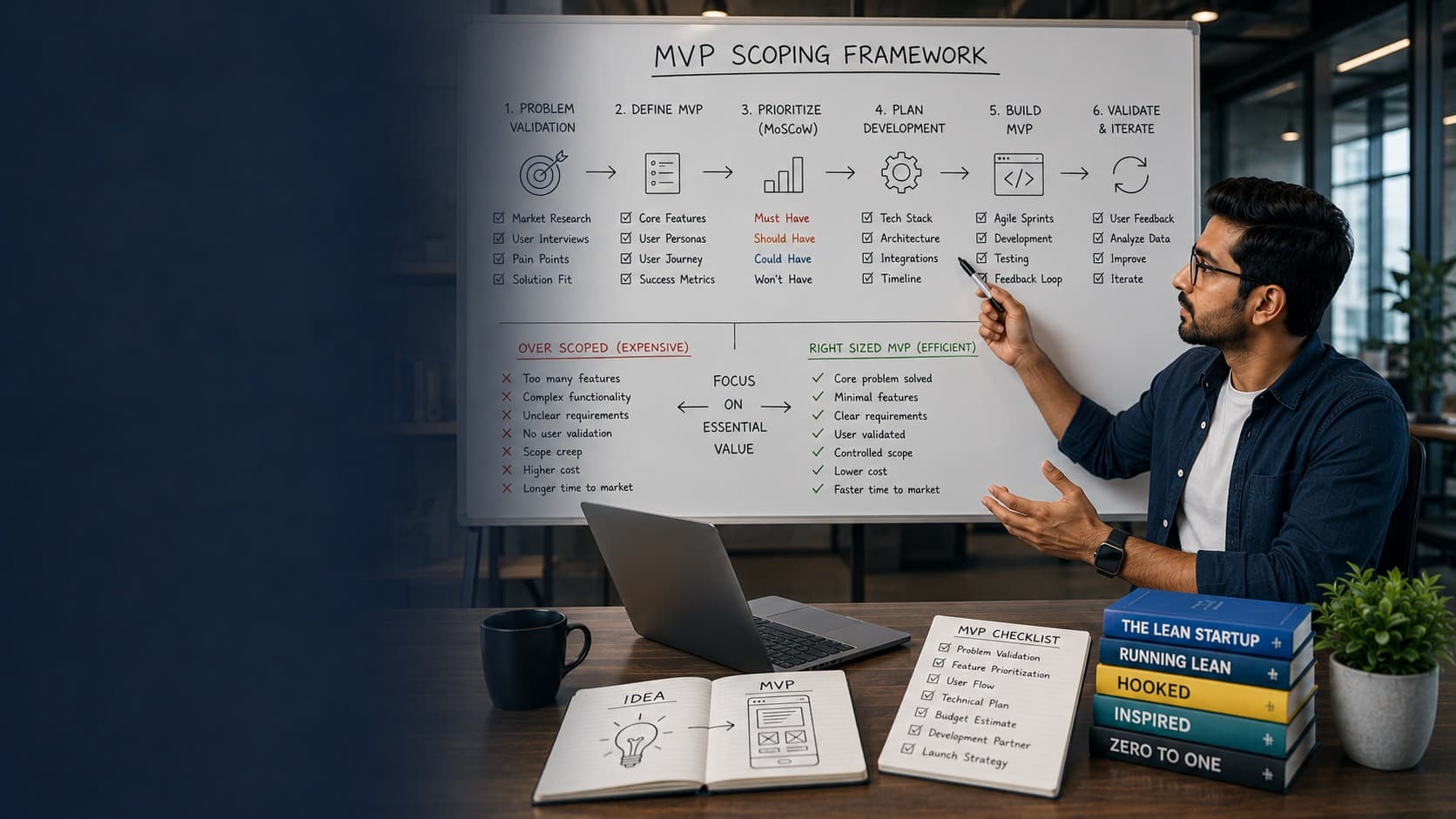
Most startups do not overspend because software development is expensive.
They overspend because the MVP scope is too large.
A founder starts with a simple product idea. Then one more feature gets added. Then another dashboard. Then an admin panel. Then payments. Then AI. Then reports. Then mobile apps. Then integrations.
Suddenly, the “lean MVP” becomes a full-scale product build.
This is where budgets stretch, timelines slip, and founders lose control of the development process.
The real skill is not just knowing how to build an MVP. It is knowing how to scope an MVP correctly before development starts.
What Does It Mean to Scope an MVP Correctly?
To scope an MVP correctly means defining the smallest useful version of your product that can test a real market assumption. It includes only the essential features required to solve one important user problem, deliver early value, collect feedback, and guide the next product decision.
A correctly scoped MVP is not the cheapest product possible.
It is the clearest product possible.
It helps founders answer:
- Does this problem matter?
- Will users engage with this solution?
- Which features are actually necessary?
- Can this product become a scalable business?
When scope is unclear, every feature feels important. When scope is clear, founders can separate what is essential from what is simply exciting.
Need Help Defining Your MVP Scope?
A focused MVP roadmap can help you reduce development cost, avoid feature creep, and launch faster with the right first version.
Plan Your MVP Scope Talk to Startup ExpertsWhy Startups Overspend on MVP Development
Startups usually overspend because they mistake “useful” features for “necessary” features.
A feature can be useful and still not belong in version one.
For example, a SaaS MVP may eventually need advanced analytics, role-based permissions, billing automation, AI insights, mobile apps, custom reports, and third-party integrations.
But if the first goal is to validate whether users want the core workflow, most of those features can wait.
The hidden causes of MVP overspending
- Unclear product requirements
- Too many target users
- No feature prioritization framework
- Founder fear of launching “too small”
- Changing priorities during development
- Building for investors instead of users
- Choosing technology before defining the business problem
The more unclear the scope, the more expensive development becomes.
The most expensive MVP is not always the one with the highest quote. It is the one that teaches the founder too little after launch.
The Founder Mistake: Treating the MVP Like Version One of the Final Product
Many founders believe an MVP should be the first version of the final product.
That mindset creates scope creep.
A better way to think about an MVP is:
An MVP is the smallest product experiment that can validate a business assumption.
This changes the entire scoping process.
Instead of asking:
“What features should the product eventually have?”
Ask:
“What do we need to build first to prove the next important assumption?”
That question protects budget, timeline, and founder focus.
A Practical Framework for Scoping an MVP Without Wasting Budget
Once you've accepted that your MVP is an experiment rather than a finished product, the next step is deciding exactly what belongs in version one.
One simple framework used by experienced startup teams is to evaluate every feature against a single question:
"Will this feature directly help us validate our primary business hypothesis?"
If the answer is no, it probably doesn't belong in the first release.
Step 1: Define One Core Problem
Avoid trying to solve five different customer problems with one MVP. The strongest products solve one meaningful problem exceptionally well.
Instead of saying:
"We want an all-in-one business platform."
Define something more focused:
"We help freelance designers manage client invoices in under five minutes."
A narrow focus naturally reduces unnecessary functionality.
Step 2: Identify the Single Success Metric
Before discussing screens or features, define what success actually looks like.
- First 100 sign-ups
- First paid customer
- Weekly active users
- Bookings completed
- Projects created
- Customer retention after 30 days
Every feature should contribute toward improving that metric.
Step 3: Prioritize Features Using the MoSCoW Method
The MoSCoW framework remains one of the simplest ways to scope software products.
- Must Have – Essential for launch.
- Should Have – Valuable but not mandatory.
- Could Have – Nice additions for future releases.
- Won't Have (Yet) – Deliberately postponed.
Founders often discover that nearly half their planned features fall into the "Could Have" category once this exercise is complete.
Planning an MVP? Start With the Right Scope.
Defining the right feature set before development begins can significantly reduce cost, accelerate launch timelines, and improve product-market validation.
Build Your MVP Roadmap Discuss Your Product IdeaHow Feature Creep Quietly Destroys Startup Budgets
Feature creep rarely happens because someone intentionally wants to overspend.
It usually happens one small decision at a time.
- "Let's add notifications."
- "Can we include dashboards?"
- "Users might eventually need analytics."
- "Let's prepare for enterprise customers."
- "We'll probably need AI recommendations."
Individually, these requests appear reasonable.
Collectively, they transform a three-month MVP into a year-long software project.
Real-World Example: Two Different MVP Scopes
Startup A
A founder wants to launch a property management platform.
Initial requirements include:
- Tenant management
- Maintenance requests
- Accounting
- AI chatbot
- Vendor management
- Reporting
- Payments
- Mobile apps
- Owner dashboards
- CRM
Estimated timeline:
12–15 months
Startup B
The founder asks one question:
"What's the smallest product landlords would actually pay for?"
Final MVP:
- Property listing
- Tenant records
- Maintenance tickets
- Email notifications
Timeline:
10–12 weeks
After launch, customer feedback determines what gets built next.
The second founder spends less, launches sooner, and starts learning from real customers much earlier.
Questions Every Founder Should Ask Before Approving a Feature
- Does this solve the primary customer problem?
- Will removing this feature stop users from getting value?
- Can we manually perform this process initially?
- Does this feature generate meaningful learning?
- Will customers pay because of this feature?
- Can this wait until Version 2?
If multiple answers suggest the feature can wait, remove it from the MVP.
How Experienced Product Teams Keep Scope Under Control
Teams that consistently launch successful MVPs usually follow a few disciplined practices.
- Lock the feature list before development begins.
- Document every product decision.
- Review change requests weekly instead of immediately approving them.
- Measure every feature against business outcomes.
- Delay optimization until customer validation exists.
At KSoft Technologies, we've seen founders dramatically reduce development costs simply by spending additional time on product scoping before writing the first line of code.
Investing a few days in planning often saves months of unnecessary development later.
Why a Smaller MVP Usually Wins
Many founders assume that adding more functionality increases their chances of success. In reality, a focused MVP often creates better user experiences, generates faster feedback, and reaches paying customers sooner.
A lean product allows your team to:
- Launch weeks or months earlier
- Reduce initial development costs
- Validate real customer demand quickly
- Collect meaningful user feedback
- Prioritize future features using actual data
- Improve investor confidence with market validation
According to CB Insights, one of the leading reasons startups fail is building products that the market doesn't actually need. Launching a focused MVP helps reduce this risk by validating assumptions before major investments are made.
Source: CB Insights Startup Failure Report
What Should Happen After Your MVP Launch?
Launch day isn't the finish line—it's the beginning of the learning process.
Instead of immediately planning Version 2, spend time understanding how users interact with your product.
Track Metrics That Matter
- User sign-ups
- Activation rate
- Customer retention
- Feature usage
- Conversion rate
- Customer feedback
These insights should guide your roadmap rather than assumptions made before launch.
Build Features Based on Evidence
Once real users begin using your product, you'll quickly discover which requests appear repeatedly and which assumptions were incorrect.
This evidence-based approach results in smarter investments and a product that evolves according to customer needs rather than internal opinions.
Ready to Build an MVP Without Overspending?
A well-scoped MVP helps you launch faster, reduce unnecessary development costs, and validate your business idea before investing in advanced functionality.
Start Planning Your MVPSchedule a Free ConsultationFinal Thoughts
The most successful startups aren't the ones that launch with the largest products—they're the ones that learn the fastest.
Scoping your MVP correctly means making intentional decisions about what to build today and what can wait until tomorrow. Every feature should have a clear purpose, support your validation goals, and contribute to solving one meaningful customer problem.
A disciplined approach to MVP planning can save months of development time, reduce costs significantly, and help founders reach product-market fit much faster.
Frequently Asked Questions
What is MVP scoping?
MVP scoping is the process of identifying the minimum set of features required to validate a product idea with real users while minimizing development time, cost, and risk.
Why do startups overspend on MVP development?
Most startups overspend because they include too many features before validating customer demand. Poor planning, changing requirements, and feature creep often lead to significant cost increases.
How many features should an MVP include?
An MVP should include only the features necessary to solve one core customer problem and validate the primary business hypothesis. Everything else can be added later.
How long should MVP planning take?
Depending on product complexity, founders typically spend one to four weeks validating ideas, defining requirements, prioritizing features, and preparing technical documentation before development begins.
What is feature creep?
Feature creep occurs when additional functionality is continuously added during development, increasing complexity, costs, timelines, and project risk without improving initial validation goals.
Should startups build every planned feature before launch?
No. Successful startups launch with only essential functionality, gather user feedback, and continuously improve the product based on real customer usage.
How do I prioritize MVP features?
Frameworks like MoSCoW prioritization, customer interviews, and business impact analysis help determine which features belong in the first release.
Can non-technical founders scope an MVP?
Yes. Non-technical founders can successfully scope an MVP by focusing on customer problems, defining user journeys, validating ideas, and working closely with experienced product teams.
When should startups add advanced features?
Advanced functionality should be introduced only after customer validation confirms demand and early product metrics justify additional investment.
Who can help define the right MVP scope?
Experienced product consultants, startup advisors, UX specialists, and software development partners can help founders identify the smallest viable feature set for launch.